




Introduction to Goniophotometry and Its Industrial Significance
Goniophotometers are specialized instruments designed to measure the spatial distribution of light emitted from luminaires, LEDs, displays, and other optical sources. These systems play a critical role in ensuring compliance with international photometric standards, optimizing lighting design, and validating product performance across industries such as LED manufacturing, urban lighting, medical equipment, and scientific research.
Among the leading solutions in this field, the LİSUN LSG-6000 Ve LSG-1890B goniofotometreler offer high-precision testing capabilities, adhering to IEC, CIE, and other global standards. This article explores their technical specifications, testing methodologies, and industry applications in detail.
Technical Specifications of the LSG-6000 and LSG-1890B Goniophotometers
The LSG-6000 is a fully automated, large-scale goniofotometre designed for high-accuracy luminous intensity distribution measurements. Its key specifications include:
- Ölçüm Aralığı: Up to 6 meters in diameter, accommodating large luminaires.
- Açısal Çözünürlük: 0.1° in both horizontal and vertical axes.
- Spektral Aralık: 380–780 nm (expandable for UV/IR applications).
- Uyum Standartları: IEC 60598-1, LM-79, CIE 70, EN 13032-1.
- Detector System: High-sensitivity CCD spectrometer with ±2% photometric accuracy.
The LSG-1890B, a more compact variant, is optimized for laboratory and industrial settings requiring rapid testing cycles:
- Ölçüm Aralığı: 1.8 meters in diameter, suitable for small to medium luminaires.
- Açısal Çözünürlük: 0.5° (adjustable to 0.1° for high-precision applications).
- Spektral Aralık: 380–780 nm (with optional extended ranges).
- Uyum Standartları: IEC 62471, IES LM-80, ANSI C78.377.
- Detector System: Silicon photodiode array with ±1.5% repeatability.
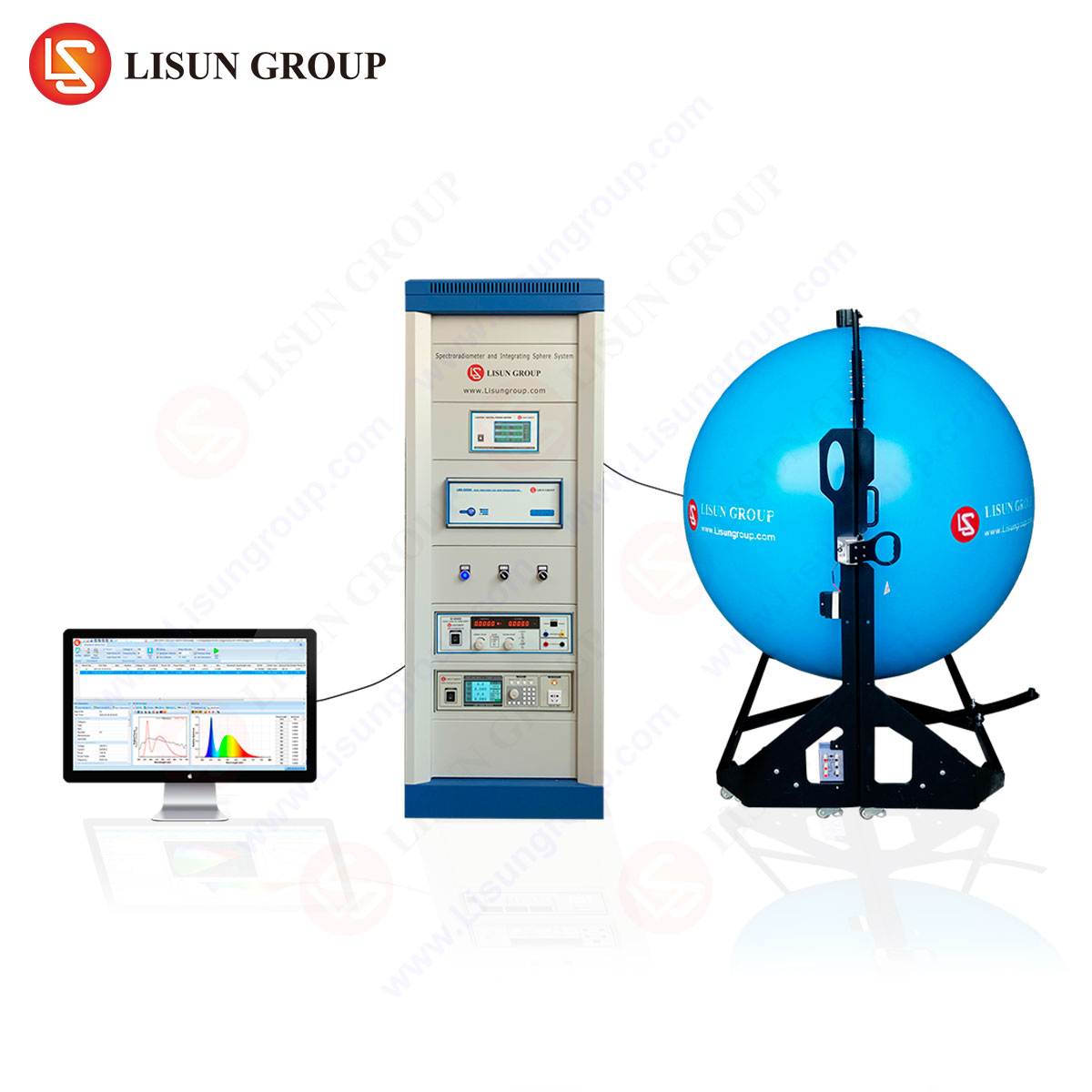
Both systems feature automated motion control, real-time data acquisition, and software integration for comprehensive photometric analysis.
Fundamental Testing Principles of Goniophotometry
Goniophotometers operate on the principle of measuring luminous intensity distribution by rotating a light source or detector across spherical coordinates (C-γ or A-α systems). The LSG-6000 and LSG-1890B utilize a Type C (moving detector, fixed light source) configuration, ensuring minimal measurement distortion.
Key measurement parameters include:
- Luminous Flux (lm): Total light output calculated via angular integration.
- Beam Angle (°): Angular width where intensity drops to 50% of peak.
- Renk Tekdüzeliği: Spatial consistency of chromaticity coordinates (CIE 1931/1976).
- Glare Evaluation: UGR (Unified Glare Rating) for indoor lighting compliance.
Data is processed through proprietary algorithms, generating IES/LDT dosyaları for lighting simulation software such as Dialux and Relux.
Endüstri Uygulamaları ve Uluslararası Standartlara Uygunluk
1. Lighting Industry and LED/OLED Manufacturing
The LSG-6000 is widely used for LM-79 (IESNA) Ve EN 13032-1 compliance, ensuring accurate reporting of luminous flux, efficacy (lm/W), and far-field intensity distribution. OLED manufacturers rely on its high angular resolution to validate emission uniformity.
2. Ekran Ekipman Testi
For LCD and micro-LED displays, the LSG-1890B measures viewing angle performance başına IEC 62977, ensuring consistent brightness and color shift characteristics.
3. Fotovoltaik Endüstrisi
Solar simulators and concentrator photovoltaics (CPV) use goniophotometers to calibrate angular response under IEC 60904-9, optimizing light capture efficiency.
4. Tıbbi Aydınlatma Ekipmanları
Surgical and diagnostic lighting must meet ISO 15004-2 for spectral stability. The LSG-6000’s spectrometer module validates flicker percentage Ve CRI (Color Rendering Index).
5. Urban and Architectural Lighting
Municipalities employ these systems to assess roadway luminaires başına ANSI/IES RP-8, minimizing light pollution while ensuring uniform illumination.
LISUN Gonyofotometrelerin Rekabet Avantajları
- Otomatik Kalibrasyon: Self-aligning optics reduce setup time.
- Çoklu Standart Uyumluluğu: Supports IEC, ANSI, CIE, and regional norms.
- Modüler Tasarım: Optional spectroradiometers and thermal chambers for extended testing.
- High-Speed Data Acquisition: Real-time processing for production-line integration.
Sıkça Sorulan Sorular (SSS)
Q1: What is the typical measurement time for a full spatial scan on the LSG-6000?
A full 4π steradian scan at 0.1° resolution takes approximately 20–30 minutes, depending on luminaire size.
Q2: Can the LSG-1890B measure UV or IR emissions?
Yes, with an optional extended-range spectrometer (250–1100 nm), it supports UV disinfection lamps Ve IR heating elements.
Q3: How does the system compensate for ambient light interference?
A darkroom enclosure and synchronized background subtraction algorithms ensure <1% stray light error.
Q4: Are these systems compatible with third-party lighting design software?
Yes, exported IES/LDT files integrate seamlessly with Dialux, Relux, and AGi32.
Q5: What maintenance is required for long-term accuracy?
Annual recalibration using NIST-traceable standards is recommended, alongside routine detector cleaning.
This technical overview underscores the LSG-6000 and LSG-1890B as industry-leading solutions for photometric validation across diverse applications. Their precision, compliance flexibility, and automation capabilities make them indispensable for R&D and quality assurance in lighting and optical technologies.
 English
  Spanish
  Russian
  Portuguese
  Turkish
  Arabic
  German
  Polish
  Italian
  French
  Korean
  Japanese
  Indonesian