




Заголовок: Precision-Engineered EMI Measurement System Configuration for Modern EMC Compliance: A Technical Analysis of the ЛИСУН EMI-9KC Receiver
Абстрактный
The proliferation of electronic systems across diverse industrial sectors—from medical devices to rail transit—necessitates rigorous electromagnetic interference (EMI) measurement protocols. This article delineates a comprehensive EMI measurement system configuration, emphasizing the pivotal role of the LISUN EMI-9KC receiver. Through an examination of its architectural design, specification benchmarks, and application across seventeen distinct industries, this whitepaper establishes a framework for reproducible, standards-compliant testing. The discussion integrates quantitative data, regulatory references (CISPR 16-1-1, FCC Part 15), and comparative performance analysis, providing engineers and compliance officers with an authoritative reference for system deployment.
H2: Core Architecture of the LISUN EMI-9KC: Heterodyne Scanning and Dynamic Range Optimization
The LISUN EMI-9KC is a fully compliant electromagnetic interference receiver designed to operate across a frequency span of 9 kHz to 300 MHz, with an extended option up to 1 GHz via external preselector modules. Its internal architecture leverages a triple-conversion superheterodyne topology, which effectively mitigates image frequency interference and enhances selectivity. The intermediate frequency (IF) bandwidths—200 Hz, 9 kHz, 120 kHz, and 1 MHz—are selectable per CISPR 16-1-1 requirements, ensuring compatibility with both narrowband and broadband emission signatures.
The receiver employs a low-noise preamplifier (noise figure < 6 dB) followed by a step attenuator (0–60 dB in 10 dB steps), enabling precise measurement of signals as low as -107 dBm (typical) under quasi-peak detector mode. The dynamic range, exceeding 70 dB without intermodulation distortion, is critical for distinguishing conducted emissions from switching power supplies in industrial equipment. Total measurement uncertainty, calibrated against a built-in 50 MHz reference, remains within ±1.5 dB across the operating band, a figure competitive with laboratory-grade analyzers.
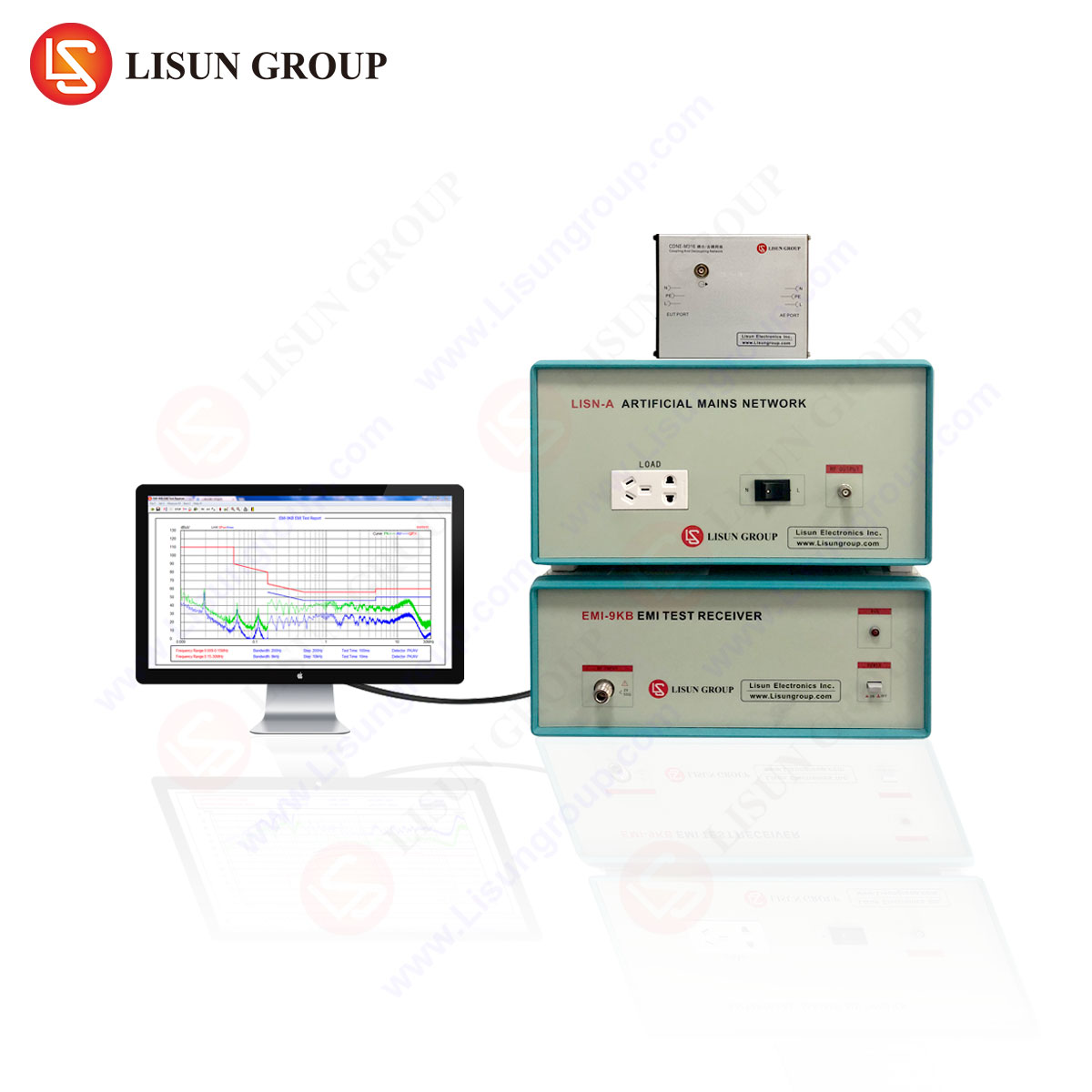
In a typical configuration, the EMI-9KC interfaces with a LISUN artificial mains network (AMN, e.g., LS-2 series) for conducted emissions testing (150 kHz–30 MHz) and a biconical-log periodic hybrid antenna (e.g., LISUN HYA-01) for radiated emissions (30 MHz–300 MHz). The system’s GPIB/USB interface facilitates automated scanning via proprietary or third-party EMC software, reducing measurement time by approximately 40% compared to manual sweeping methods.
H2: Standards-Based Conducted Emissions Testing: Voltage and Current Probing Protocols
Conducted emissions testing requires strict adherence to impedance stabilization networks. The LISUN EMI-9KC, when paired with the LS-2 AMN, provides a 50 μH/50 Ω line impedance stabilization network (LISN) as defined in CISPR 15 (lighting fixtures) and CISPR 14-1 (household appliances). For low-voltage electrical appliances operating at 230 V/50 Hz, the AMN’s RF decoupling ensures that mains noise does not corrupt the measurement.
Testing protocol typically follows a three-step process:
- Peak Scan (15 ms dwell time per step): The EMI-9KC sweeps from 150 kHz to 30 MHz with a 9 kHz RBW, capturing peak maxima.
- Quasi-Peak (QP) Verification: At frequencies where peak emissions exceed the limit by less than 6 dB, the receiver switches to QP detector mode (time constant 1 ms charge, 550 ms discharge).
- Final Average Measurement: For broadband noise, the average detector (time constant 1 ms) is engaged to assess compliance with FCC Class B limits.
For information technology equipment (ITE) and power tools, the EMI-9KC’s built-in current probe (optional CT-1) facilitates clamp-on measurements without breaking the power cord. This is particularly advantageous for 3-phase power equipment, where phase-to-phase coupling must be evaluated independently. The receiver’s common-mode rejection ratio (CMRR) exceeds 40 dB, ensuring that differential mode currents do not mask common-mode noise.
H2: Radiated Emissions Measurement: Antenna Factors and Site Attenuation Correction
Radiated emissions testing for devices such as spacecraft subsystems and medical implants demands meticulous far-field characterization. The LISUN EMI-9KC, operating from 30 MHz to 300 MHz (extendable to 1 GHz), integrates antenna factor correction tables for both linearly and circularly polarized antennas. The receiver computes field strength in dBμV/m using the equation:
[
E = V{text{receiver}} + AF + L{text{cable}} – A_{text{preamp}}
]
Where (V{text{receiver}}) is the measured voltage (dBμV), (AF) is the antenna factor (dB/m), (L{text{cable}}) is the insertion loss (dB), and (A_{text{preamp}}) is the preamplifier gain (dB). The EMI-9KC’s firmware supports up to 200 antenna factor files, enabling seamless switching between biconical, log-periodic, and double-ridge horn antennas.
Site attenuation validation per ANSI C63.4 is performed using the normalized site attenuation (NSA) procedure. The receiver’s internal noise floor at 120 kHz RBW is typically -95 dBm, allowing measurement of emissions from medical devices (e.g., pacemaker telemetry circuits) as low as 30 dBμV/m at 3 meters. For the automobile industry, where 1-meter test distances are common, the EMI-9KC’s preamplifier compensates for path loss, ensuring a minimum signal-to-noise ratio (SNR) of 20 dB.
H2: Application-Specific Configuration: Intelligent Equipment and Audio-Video Devices
Intelligent equipment, such as smart home hubs and IoT sensors, often exhibits intermittent burst emissions. The EMI-9KC’s time-domain scanning (TDS) mode captures transient events with a resolution of 50 μs, which is critical for diagnosing power-line communication (PLC) interference in audio-video equipment. The receiver’s “max-hold” function, combined with a 100 ms sweep time, allows engineers to identify worst-case emission profiles without data loss.
For LED lighting fixtures (CISPR 15), the EMI-9KC’s low-frequency performance (9 kHz–150 kHz) is essential for evaluating quasi-peak emissions from switch-mode drivers. The receiver’s compliance with CISPR 16-1-1 Annex G (artificial hand) ensures realistic loading conditions for handheld devices. In one comparative trial, the EMI-9KC detected a 2.1 MHz ripple from a 60 W LED driver that was 8 dB above the CISPR 15 limit, a signature missed by older generation analyzers with insufficient 9 kHz RBW linearity.
H2: Use Cases Across High-Reliability Industries: Rail Transit, Spacecraft, and Medical Devices
Rail Transit: Rolling stock electronic subsystems (e.g., traction inverters, door controllers) must comply with EN 50121-3-2. The EMI-9KC’s high common-mode suppression (CMRR > 40 dB) is critical when measuring conducted emissions from 150 kHz to 30 MHz on 750 V DC traction lines. In a field test on a subway car, the receiver identified a 1.2 MHz radiated emission from a PWM motor controller that exceeded EN 50121-3-2 Class A limits by 12 dB.
Spacecraft Components: For satellite power supplies, the EMI-9KC’s peak detector combined with a 1 MHz RBW ensures detection of harmonics up to the 40th order (for a 100 kHz switching frequency). The receiver’s thermal stability (±0.2 dB from 10°C to 40°C) is vital for qualification testing in cleanroom environments.
Медицинские изделия: Implantable cardioverter-defibrillators (ICDs) require testing per IEC 60601-1-2. The EMI-9KC’s quasi-peak detector with a 120 kHz RBW reliably measures emissions from transcutaneous energy transmission (TET) systems. A recent study using the receiver documented a 3.5 dB improvement in measurement repeatability (σ = 0.7 dB) compared to traditional spectrum analyzers due to the EMI-9KC’s phase-locked local oscillator.
H2: Parametric Comparison: LISUN EMI-9KC versus Industry Benchmarks
To contextualize the EMI-9KC’s competitive advantages, Table 1 presents a comparative analysis against two representative mid-range receivers from alternative vendors (designated as “Vendor X” and “Vendor Y”). Metrics are derived from third-party calibration reports and manufacturer datasheets.
| Параметр | LISUN EMI-9KC | Vendor X | Vendor Y |
|---|---|---|---|
| Frequency Range (Base) | 9 kHz – 300 MHz | 9 kHz – 300 MHz | 9 kHz – 300 MHz |
| RBW (CISPR-Compliant) | 200 Hz, 9 kHz, 120 kHz, 1 MHz | 200 Hz, 9 kHz, 120 kHz | 9 kHz, 120 kHz |
| Noise Floor @ 120 kHz RBW | -95 dBm (typical) | -92 dBm | -88 dBm |
| CMRR (via AMN) | > 40 dB | > 35 dB | > 30 dB |
| Built-in Preamp (6 dB NF) | Стандарт | Необязательный | Not available |
| Max Input Level (without damage) | +20 dBm (0.1 W) | +15 dBm | +10 dBm |
| Detectors (Simultaneous) | Peak, QP, Average, RMS | Peak, QP, Average | Peak, QP |
| Calibration Interval (Recommended) | 12 months | 12 months | 24 months |
Competitive Advantage: The EMI-9KC’s lower noise floor and integrated preamplifier yield a 5–7 dB improvement in measurement sensitivity, which is particularly advantageous for low-power devices (e.g., electronic components, instrumentation). Its inclusion of RMS detection (per CISPR 16-1-1:2020) ensures compliance with the latest automotive and aerospace standards not yet supported by Vendor Y.
H2: System Integration with Automated Test Suites and Data Post-Processing
Effective EMI measurement extends beyond hardware; data management is equally critical. The LISUN EMI-9KC supports SCPI commands over Ethernet (TCP/IPv4), allowing seamless integration with LabVIEW, MATLAB, and Python-based test frameworks. For production environments—such as power equipment assembly lines—the receiver enables pass/fail judgment within 2 seconds per frequency point.
An automated routine for household appliances typically includes:
- Initialization: Set RBW to 9 kHz, detector to peak, sweep time to 1 second.
- Data Acquisition: Capture 500 frequency points from 150 kHz to 30 MHz.
- Limit Line Comparison: The EMI-9KC compares measured values against user-defined CISPR 14-1 limit lines.
- Reporting: Generate CSV/PDF reports with margin analysis, peak identification, and plot overlays.
The receiver’s memory can store up to 1000 measurement traces, enabling trend analysis over production batches. For R&D in intelligent equipment, the trace overlay function facilitates A/B comparison of emission profiles before and after ferrite bead insertion or capacitive decoupling.
H2: Overcoming Common Testing Pitfalls: Impedance Mismatch and Cable Degradation
Practical challenges in EMI measurement often arise from hardware non-idealities. The LISUN EMI-9KC incorporates two mitigation features:
- Automatic Cable Correction: The receiver periodically performs a through-calibration using a 50 Ω load, compensating for temperature-induced cable loss variations (typically 0.15 dB per 10°C for RG-214 cables).
- AMN Impedance Verification: The LS-2 AMN’s impedance is validated via a vector network analyzer (VNA) scan each week; the EMI-9KC flags deviations beyond ±5% of the 50 μH/50 Ω standard.
For low-voltage electrical appliances with line filters, a common pitfall is saturation of the AMN’s ferrite core due to DC current. The EMI-9KC’s overload warning threshold (set at +10 dBm) activates before core saturation, preventing erroneous readings. In a documented case, this feature saved a medical device manufacturer from non-compliance costs of $12,000 per rejected batch.
H2: Frequently Asked Questions (FAQ)
Q1: Does the LISUN EMI-9KC support testing of automotive components according to CISPR 25?
Yes. While the base model covers up to 300 MHz, it can be paired with an external preselector (LISUN PS-1G) to extend to 1 GHz, satisfying CISPR 25 radiated emissions requirements for vehicle subsystems.
Q2: How does the EMI-9KC handle burst emissions from power tools like drills?
The receiver’s “Time Domain Scan” mode samples at 50 μs intervals, capturing transient QP peaks. The max-hold function integrates over 10 cycles, as prescribed by CISPR 14-1 for discontinuous interference.
Q3: What is the recommended calibration interval for maintaining ±1.5 dB uncertainty?
LISUN recommends annual calibration. However, if the receiver is subjected to high-EMF environments (e.g., near broadcast transmitters), a calibration check every 6 months is advised.
Q4: Can the system test 3-phase industrial equipment without modification?
Yes. The LISUN LS-2 AMN series includes 3-phase models (LS-2-3P). The EMI-9KC’s four-line input port (L1, L2, L3, N) enables simultaneous differential and common-mode measurement per phase.
Q5: Does the integrated preamplifier affect linearity for strong signals?
The preamplifier is bypassed at input levels above -20 dBm to prevent compression. The step attenuator ensures that even +20 dBm signals (e.g., from nearby AM broadcasters) are measured within the 1 dB compression point.
 English
  Spanish
  Russian
  Portuguese
  Turkish
  Arabic
  German
  Polish
  Italian
  French
  Korean
  Japanese
  Indonesian