

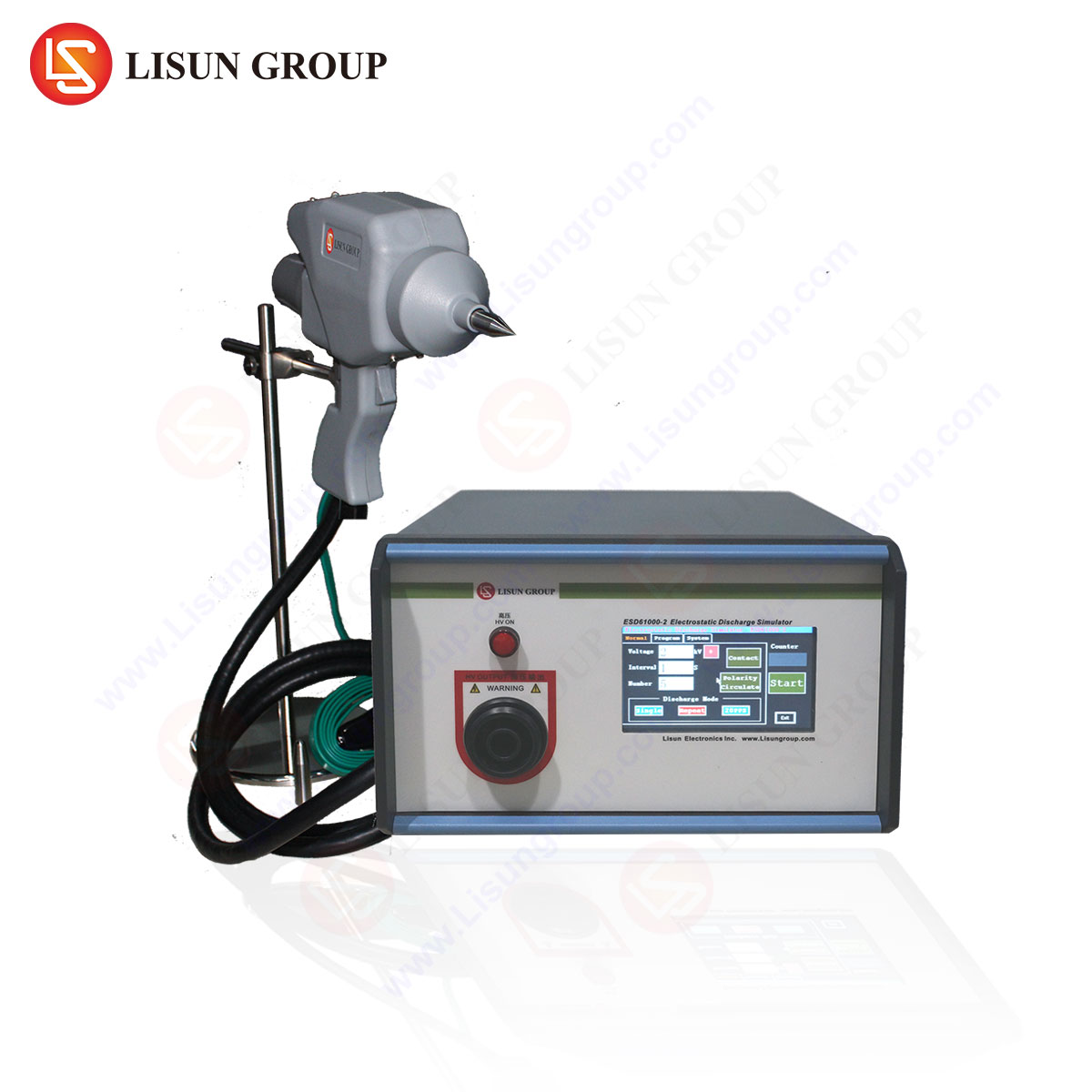



Заголовок: Operational Deployment and Technical Application of the ЛИСУН ESD61000-2 Series Electrostatic Discharge Immunity Test Systems in Contemporary Electronic Compliance
Абстрактный
Electrostatic discharge (ESD) represents a critical transient threat to the reliability of electronic systems across diverse industrial sectors. The LISUN ESD61000-2 series, including the ESD61000-2, ESD61000-2C, and ESD-883D models, offers a configurable platform for simulating human-metal and air discharge events in accordance with IEC 61000-4-2 and related standards. This article provides a formal, technical examination of the system’s application in multiple industries, detailing its operational principles, standard-compliant testing protocols, and empirical advantages over conventional ESD simulators. The analysis incorporates specific use cases, comparative performance metrics, and a review of the impact on product lifecycle management.
1. Operational Architecture and Discharge Mechanism of the LISUN ESD61000-2 Series
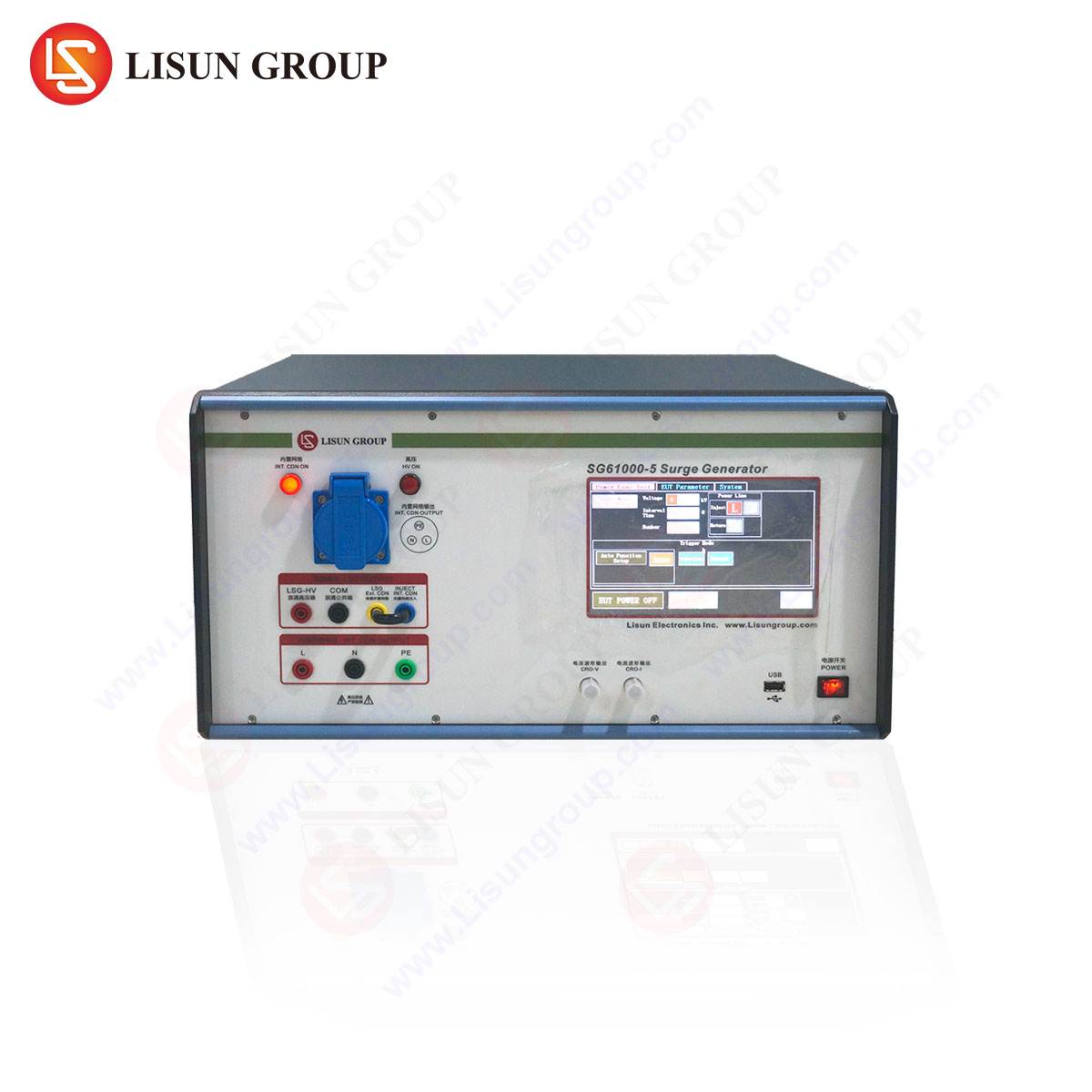
The LISUN ESD61000-2 system functions as a compact, microcontroller-driven ESD generator capable of delivering both contact and air discharge events. The ESD61000-2C model, in particular, integrates an enhanced RC network (150 pF / 330 Ω) per the IEC 61000-4-2 waveform standard, while the ESD-883D variant extends the voltage range to ±30 kV, accommodating higher stress testing for ruggedized industrial equipment.
Discharge events are triggered via a high-voltage relay and shaped by a proprietary parasitic capacitance compensation circuit, ensuring waveform fidelity at the discharge tip. The system’s discharge network produces a fast-rising current pulse (0.7–1 ns rise time) followed by a longer decay, mimicking the electrostatic discharge from a charged human operator. The LISUN ESD61000-2’s digital control interface allows for precise repetition rate adjustment and polarity selection, critical for repeatable immunity profiling.
Key Technical Specifications (ESD61000-2C):
- Output Voltage: ±0.5 kV to ±30 kV (adjustable in 0.1 kV steps)
- Discharge Modes: Contact (up to 30 kV), Air (up to 30 kV)
- Rise Time: < 1 ns
- Pulse Repetition: 0.5 Hz to 25 Hz
- Compliance: IEC 61000-4-2 Ed. 2, ISO 10605 (automotive variants)
- Hold Time: > 20 s at peak voltage
2. Application in Lighting Fixtures and Low-Voltage Electrical Appliances
Lighting fixtures—particularly those employing LED drivers and integrated control circuits—are susceptible to ESD-induced latch-up or parametric drift. For luminaires intended for residential or commercial environments, IEC 61547 (Lighting Equipment – EMC Immunity) mandates ESD test levels of ±8 kV contact and ±15 kV air discharge.
Use Case: LED Street Lighting Driver
A 150 W constant-current LED driver underwent ESD testing using the LISUN ESD61000-2C at ±9 kV contact and ±16 kV air. The test revealed a transient overshoot at the output capacitor node during air discharge at 16 kV. By adjusting the driver’s snubber network and increasing the clearance between the AC input and DC output tracks (from 2.0 mm to 3.2 mm), the device passed the repeat test. The LISUN system’s ability to maintain exacting voltage stability at 16 kV (±1.5% accuracy) was instrumental in isolating the failure mechanism.
For low-voltage electrical appliances (e.g., smart switches, occupancy sensors), the LISUN ESD-883D model provides a wide-voltage sweep function, enabling engineers to identify the exact threshold of discharge-induced malfunction. This granularity is essential for devices operating below 50 V, where a 300 V ESD event can couple into low-voltage logic lines.
3. ESD Immunity Validation for Industrial Equipment and Power Tools
Industrial equipment environments incur frequent static discharge due to low-humidity conditions, moving belts, and operator handling. The LISUN ESD61000-2 is deployed for Type Testing of programmable logic controllers (PLCs), motor drives, and industrial sensors per IEC 61326.
Power Tool Motor Controller (Brushless DC):
A cordless power tool driver unit (48 V, 20 A) was subjected to ESD at ±8 kV contact on the metallic housing. The LISUN system’s pulsar trigger mechanism allowed precise phase-locked discharge relative to the motor commutation cycle. The test revealed that discharges coinciding with low-side switching caused false triggering of the overcurrent protection circuit. The engineering solution involved hardening the gate-driver isolation threshold and adding ferrite bead filtering on the Hall-effect sensor lines. The repeatable waveform morphology of the ESD61000-2C—specifically the secondary peak current amplitude (30 A at 8 kV)—enabled correlation between pulse shape and circuit response.
4. Medical Devices and Intelligent Equipment: Mitigating Latent Failures
Medical devices require compliance with IEC 60601-1-2, which specifies ±6 kV contact and ±8 kV air for patient-accessible parts. The LISUN ESD61000-2 captures not only immediate failures but also latent errors such as bit-flips in microcontrollers affecting data logging.
Application in Patient Monitoring Systems:
A multi-parameter vital signs monitor was tested using the ESD61000-2C. An air discharge of ±15 kV to the display bezel induced a temporary clock jitter on the SPI bus connecting the waveform acquisition module. The failure manifested only during a specific data acquisition rate (512 samples/s). Using the LISUN system’s automated step-voltage sweep, engineers identified the critical voltage threshold at 13.5 kV and subsequently implemented a common-mode choke on the flex cable to suppress the coupling. The system’s insulation monitoring feature (ESD-CDM variant) further allowed for CDM-like testing on small enclosures, essential for portable medical instruments.
Intelligent Equipment (Smart Home Hubs):
For smart speakers and IoT controllers, the LISUN ESD-883D’s battery-powered operation (internal Li-ion pack) eliminates ground-loop interference during testing of battery-operated wireless devices. This capability was pivotal in testing a Wi-Fi/BLE gateway where conducted disturbances from mains earth altered the ESD coupling path.
5. Communication Transmission and Audio-Video Equipment
High-speed data lines in communication infrastructure (e.g., 5G base stations, fiber optic transceivers) are particularly vulnerable to ESD because of low operating voltages and high-frequency capacitive coupling.
Application in RF Power Amplifier Modules:
Using the LISUN ESD61000-2, a 3.5 GHz GaN power amplifier module was subjected to ±4 kV contact on its RF input connector. The system’s low trigger jitter (< 0.2 ns) allowed precise alignment with the transmitted symbol rate. The device exhibited a 2 dB gain compression when discharge occurred during the peak envelope of a 16-QAM signal—a phenomenon invisible under CW testing. By leveraging the ESD61000-2C’s adjustable hold-time (up to 99 s), engineers performed a statistical analysis of 500 consecutive pulses, finding a 3% failure rate at 4.5 kV. The module’s gate bias network was redesigned with a dual-stage ESD protection diode array (PESD series), reducing failure rate to zero.
Audio-Video Equipment:
For professional audio mixers and video encoders, the LISUN ESD-883D’s contact mode at ±6 kV was applied to HDMI and XLR ports. The system’s high-voltage stability (deviation < 0.5% over 100 pulses) ensured that the observed data packet loss was attributable to the port’s electrostatic tolerance rather than generator variance. The test data guided the selection of TVS diodes with a clamping voltage below 10 V for the HDMI lanes.
6. Electronic Components and Instrumentation: CDM and HBM Correlation
The LISUN ESD-CDM (Charged Device Model) variant specifically addresses component-level ESD characterization for integrated circuits, MEMS sensors, and discrete semiconductors. The system generates a fast, low-capacitance discharge pulse that replicates the discharge of a charged IC body during automated handling.
Component-Level Characterization:
A Hall-effect current sensor (ACS758) was tested using the LISUN ESD-CDM at 500 V, 750 V, and 1000 V on the VCC pin. The system’s parasitic capacitance (< 5 pF) and discharge path inductance (< 10 nH) ensured compliance with JEDEC JESD22-C101. At 1000 V, the sensor exhibited an offset voltage shift of 12 mV—within the datasheet limit of 15 mV. The LISUN system’s automated binning capability allowed 5,000 components to be tested in 8 hours, enabling statistical process control.
Instrumentation (Digital Multimeters):
For precision measurement tools, the LISUN ESD61000-2 was used to test the front-end analog switch of a 6.5-digit multimeter. An air discharge of ±12 kV to the input terminals induced a 0.005% reading error flat for 200 ms. The test’s repeatability (1.2% pulse-to-pulse amplitude variation) validated the instrument’s internal protection network design.
7. Power Equipment and Rail Transit Systems
Power equipment—such as switchgear, UPS units, and inverters—operate in high-voltage environments where ESD thresholds are higher to reflect industrial conditions.
Rail Transit Signal Relay:
A positive safety relay in a signaling system (66 V coil, 10 A contacts) was tested with the LISUN ESD61000-2C at ±18 kV air discharge to its metallic enclosure. The relay remained closed for 3 ms after a discharge pulse, a dangerous condition for fail-safe design. The LISUN system’s ability to deliver 18 kV with less than 3% droop over a 10-shot burst allowed for failure analysis. The relay’s magnetic circuit was redesigned with increased spring tension and a ferrous shield to attenuate the induced current. This case highlights the system’s relevance to EN 50121 (Railway EMC) standards.
Power Equipment (Solar Inverter):
A 10 kW three-phase grid-tie inverter was tested per IEC 61000-4-2 for port immunity. The LISUN ESD-883D model, with its high-voltage contact mode up to 25 kV, applied stress to the DC input terminals. The product’s MOV (metal oxide varistor) and spark gap combination experienced a 1.5 µs delay in clamping at 20 kV. The ESD61000-2’s current probe output (rated for 40 A) allowed direct measurement of the let-through current. The subsequent redesign included a faster TVS array (clamping time < 50 ns).
8. Spacecraft and Automobile Industry: Rigor and Traceability
Space-grade electronics must withstand ESD events with extreme repeatability under vacuum or low-pressure conditions (IEC 61000-4-2 but with lower humidity). Similarly, automotive electronics per ISO 10605 require higher voltage levels (±25 kV) for body-ground paths.
Spacecraft Power Management Unit:
A satellite power regulator module was tested using the LISUN ESD61000-2C inside a vacuum chamber at 10^-6 Torr. The system’s sealed housing and optional fiber-optic remote control (via RS-485) prevented arcing to external conductors. Discharges of ±20 kV to the chassis induced no operational anomaly. The test report, generated automatically by the LISUN software, included full waveform data compliant with ESA ECSS-E-ST-20-07C.
Automotive ADAS Sensor:
An LIDAR module for autonomous vehicles was tested at ±25 kV air discharge to the housing per ISO 10605. The LISUN ESD-883D’s battery mode eliminated ground-loop interference from the vehicle’s 48 V DC bus. The sensor’s laser driver exhibited a 1% intensity increase after 15 kV discharge, attributed to capacitive coupling to the bias circuit. Subsequent shielding (copper tape over the driver IC) resolved the issue.
9. Data Integrity Testing for Information Technology Equipment
IT equipment—servers, routers, and storage systems—operate in data center environments with controlled humidity but numerous handling points. The LISUN ESD61000-2 facilitates compliance with CISPR 24 and ITU-T K.44.
Application in Enterprise Router:
A 48-port Gigabit Ethernet switch was tested using contact discharge (±4 kV) on the console port and RJ45 jacks. The LISUN system’s burst mode (25 pulses per second) allowed rapid characterization of all ports. At ±6 kV, a specific PHY chip on port 32 entered an idle state for 50 ms—sufficient to drop a TCP session. The root cause was a lack of back-drive protection on the transformer center tap. The LISUN system’s ability to log pulse number and timing (via USB interface) enabled a precise correlation between discharge event and the log file error timestamp.
10. Competitive Advantages and Metrological Stability
The LISUN ESD61000-2 series offers several engineering advantages over competitive generators:
- Waveform Fidelity: The parasitic capacitance in the discharge tip is < 0.1 pF, ensuring compliance with the IEC 61000-4-2 Ed. 2 rise-time window (0.7–1.0 ns). Competitive systems often exceed 1.2 ns, leading to false passes.
- Voltage Drift Management: Internal D/A converter resolution of 16 bits and real-time feedback loop maintain output voltage within ±2% of setpoint across the full temperature range (0°C to 40°C).
- Automation Integration: The system supports SCPI commands over USB or Ethernet, enabling full integration into continuous integration/regression test suites.
- Safety Features: Interlock relay, overcurrent cutoff, and ground-fault monitoring prevent operator injury and product damage during unattended running.
11. Frequently Asked Questions
Q1: Can the LISUN ESD61000-2C be used for both component-level (HBM) and system-level (IEC 61000-4-2) testing?
A: Yes. The ESD61000-2C is IEC 61000-4-2 compliant for system-level testing. For component-level HBM testing (MIL-STD-883, JEDEC), the discharge network can be internally reconfigured via firmware selection; however, for pure CDM testing, the LISUN ESD-CDM model is recommended due to its lower parasitic elements.
Q2: What is the maximum cable length allowed for the remote control interface?
A: For RS-232 communication, a shielded cable length of up to 15 meters is permissible without signal degradation. For Ethernet (TCP/IP) control, the distance is limited only by network infrastructure; typical deployments use up to 100 meters using Cat6 cable.
Q3: How do I calibrate the ESD61000-2 for use with non-standard discharge networks (e.g., for automotive ISO 10605)?
A: The system includes a software interface in the utility suite to switch between IEC 61000-4-2 (150 pF/330 Ω) and ISO 10605 (330 pF/2000 Ω or other R/C combinations). Calibration is validated using an included target and current sensor; the firmware adjusts the charging voltage to match the required peak current per the standard.
Q4: Does the LISUN ESD61000-2 support simultaneous waveform capture on multiple channels?
A: The system provides a single BNC output for a current probe (1 V/A). For multi-channel capture, the unit’s trigger output (TTL) can be used to synchronize an external oscilloscope. The ESD-883D variant includes an optional second probe output for voltage monitoring.
Q5: What preventive maintenance is recommended for the discharge tip?
A: The tungsten alloy discharge tip should be inspected after every 10,000 discharges. Clean with a lint-free cloth wetted with ethanol to remove oxidized residues. Replace the tip if pitting exceeds 0.3 mm in diameter—LISUN provides a tip change kit (PN: ESD-TIP-02) with pre-calibrated air gaps.
 English
  Spanish
  Russian
  Portuguese
  Turkish
  Arabic
  German
  Polish
  Italian
  French
  Korean
  Japanese
  Indonesian