




Título: Maximizing LED Performance Testing with LISUN Large Esfera Integradora Solutions
Resumo
The proliferation of solid-state lighting technologies, including high-power LEDs and OLEDs, has necessitated the evolution of photometric, colorimetric, and radiometric measurement methodologies. Accurate characterization of total luminous flux, spectral power distribution (SPD), correlated color temperature (CCT), color rendering index (CRI), and chromaticity coordinates is critical for compliance with international standards such as IES LM-79, CIE 127, and CIE 13.3. This article examines the technical principles and operational advantages of utilizing large integrating spheres, specifically the LISUN LPCE-2 (LISUN Precise Color & Electrical) e LPCE-3 systems, in conjunction with high-resolution spectroradiometers. This analysis provides a framework for optimizing measurement accuracy across diverse industries, including automotive lighting, aerospace, medical equipment, and urban lighting design.
1. Theoretical Foundations of Integrating Sphere Photometry for High-Power Sources
O esfera de integração, first conceptualized by W.E. Sumpner and R. Ulbricht, remains the gold standard for measuring total luminous flux. Its operational principle relies on the spatial integration of light reflected from a highly diffuse, high-reflectance (typically >94% in the visible spectrum) coating, such as barium sulfate or PTFE. For high-power LEDs and large luminaires, the sphere diameter must be sufficiently large (e.g., 1.0 m, 1.5 m, or 2.0 m) to minimize self-absorption errors and maintain the accuracy of the cosine-corrected detector.
The LISUN LPCE-2 and LPCE-3 systems address a fundamental limitation in traditional sphere design: the non-ideal behavior of the sphere as a uniform radiance source when testing directional or polarized light sources. By employing an auxiliary lamp method and a baffle system aligned to ASTM and CIE protocols, these systems correct for the absorption characteristics of the device under test (DUT). The operational equation for corrected flux measurement is:
[
Phi{DUT} = frac{Y{DUT} – Y{dark}}{Y{std} – Y{dark}} times Phi{std} times alpha(lambda)
]
where (alpha(lambda)) represents the wavelength-dependent self-absorption correction factor derived from the auxiliary lamp. This correction is essential for automotive lighting and stage lighting applications where reflectors and secondary optics alter the angular distribution of emitted light.
2. The LISUN LPCE-2 and LPCE-3: System Architecture and Metrological Specifications
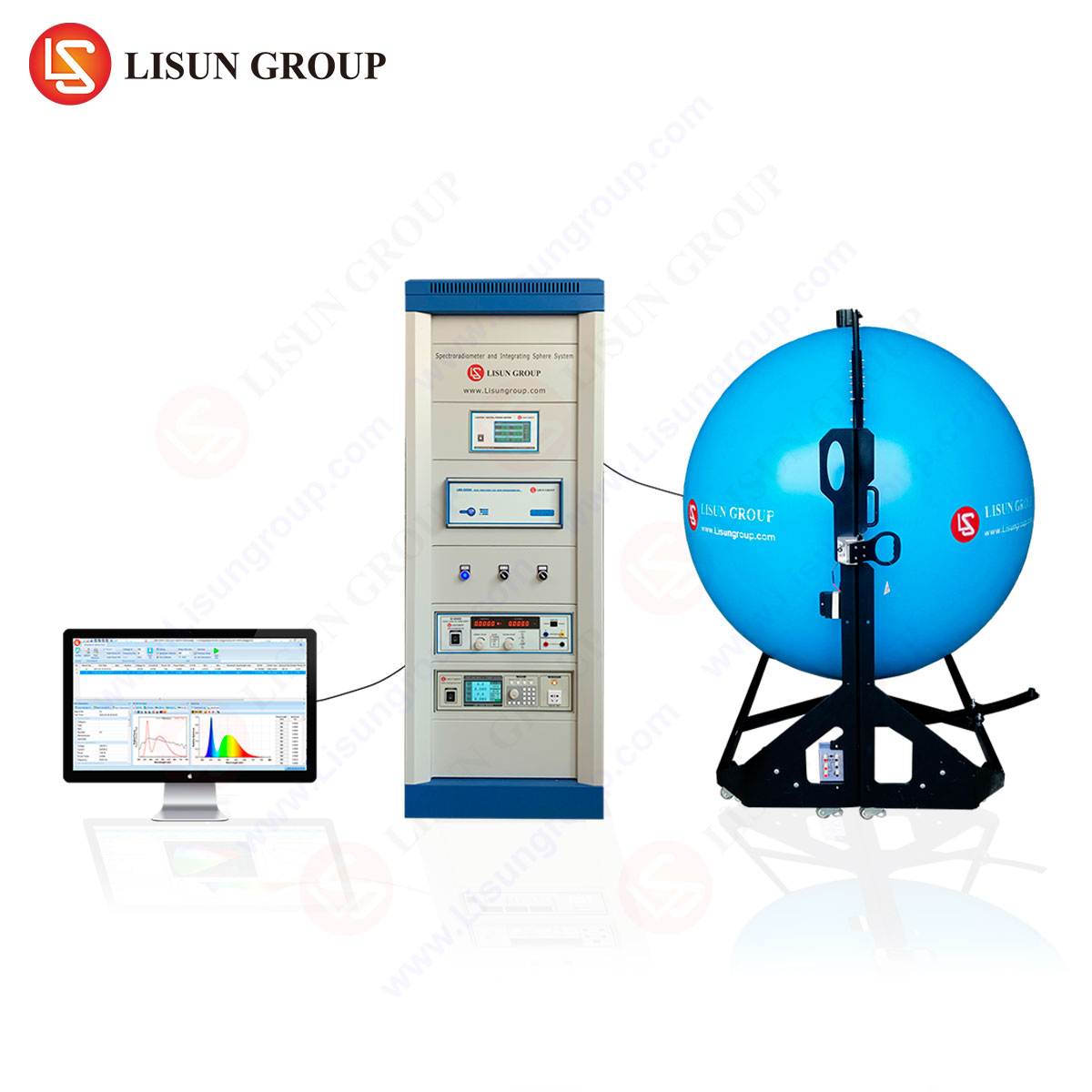
The LISUN integrating sphere and spectroradiometer systems are designed as turnkey solutions for high-precision photometry. The LPCE-2 is optimized for general laboratory R&D and quality control, while the LPCE-3 integrates a high-speed array spectroradiometer for transient and pulsed measurement scenarios.
Table 1: Comparative Specifications of LISUN Integrating Sphere Systems
| Parâmetro | LPCE-2 Specification | Especificação LPCE-3 |
|---|---|---|
| Sphere Diameter Options | 0.3 m, 0.5 m, 1.0 m, 1.5 m, 2.0 m | 0.5 m, 1.0 m, 1.5 m, 2.0 m |
| Gama de comprimentos de onda | 380 nm – 780 nm (standard) | 200 nm – 1050 nm (extended UV-VIS-NIR) |
| Spectroradiometer Resolution | 1.0 nm (FWHM) | 0.5 nm (FWHM) |
| Photometric Accuracy | ±2.5% (traceable to NMI) | ±1.5% (traceable to NMI) |
| CCT Measurement Range | 1,500 K – 25,000 K | 1,000 K – 100,000 K |
| Maximum DUT Power | 200 W (thermal limit) | 500 W (active cooling integrated) |
| Measurement Speed (Full Scan) | 5 seconds | 0.5 seconds (burst mode) |
The LPCE-3 spectroradiometer incorporates a cooled CCD array to minimize dark current noise, enabling accurate measurement of low-luminance sources such as OLED displays and medical lighting equipment. The system interface supports real-time calculation of luminous efficacy (lm/W), color rendering indices (Ra, R1-R15), and TM-30 metrics (Rf, Rg).
3. Application-Specific Testing Protocols in the Lighting and Display Industries
3.1 LED and OLED Manufacturing Quality Control
In high-volume LED production, the LISUN LPCE-2 facilitates binning based on luminous flux, CCT, and chromaticity tolerance. The system’s optical fiber coupling reduces stray light interference, allowing for the detection of spectral shifts below 2 nm. For OLED panels used in display equipment, the LPCE-3’s fast acquisition time (0.5 seconds) is critical for capturing emissive layer aging during accelerated life testing (ALT). Standard compliance with IES LM-79 requires the sphere size to be at least ten times the DUT’s longest dimension; the LISUN 2.0 m sphere satisfies this criterion for large-area OLED modules.
3.2 Automotive Lighting Testing (ECE, SAE, and FMVSS 108)
Automotive headlamps and signaling devices demand rigorous measurement of luminous intensity distribution and chromaticity coordinates. The integrating sphere method, as implemented in the LPCE-2 system, provides the total luminous flux required for the calculation of luminous efficacy. The system’s spectroradiometer simultaneously measures SPD to verify compliance with SAE J578 (color specifications for signal lights). For adaptive driving beam (ADB) modules, the LPCE-3’s high-speed measurement capability captures transient flux variations during dynamic switching.
3.3 Aerospace and Aviation Lighting
Aerospace lighting—including runway edge lights, obstruction lights, and cabin ambient lighting—requires photometric measurements under controlled environmental conditions. The LISUN large integrating sphere (1.5 m or 2.0 m) accommodates luminaires with large heat sinks and complex optics. The system’s NIST-traceable calibration ensures compliance with FAA Advisory Circular 150/5345-53. The extended wavelength range of the LPCE-3 (200 nm – 1050 nm) is vital for UV-A and IR-A characterization in medical lighting and phototherapy equipment.
4. Integration of Spectroradiometry: Spectral Analysis and Colorimetric Accuracy
The transition from filtered photodiode detectors to array spectroradiometers has significantly improved the resolution of colorimetric measurements. The LISUN LPCE-3 employs a Czerny-Turner optical configuration with a holographic grating and a linear CCD array. This design mitigates the stray light errors inherent in cross-flow spectrometers.
When calculating CIE 1931 (x, y) chromaticity coordinates, the system integrates the SPD across the visible spectrum with a step size of 0.1 nm using interpolation algorithms. The resulting uncertainty in u’ and v’ coordinates is less than ±0.002 (Δu’v’), which is critical for display equipment testing and urban lighting design where precise color consistency is required.
For the photovoltaic industry, the LPCE-2 can be adapted with a quartz window and calibrated reference cell to measure spectral mismatch corrections for solar simulators. The system’s ability to output absolute spectral irradiance (W/m²/nm) supports the calibration of reference solar cells per IEC 60904-3 standards.
5. Overcoming Spatial Non-Uniformity and Self-Absorption Errors in Large Spheres
One of the primary sources of uncertainty in integrating sphere measurements is the spatial non-uniformity of the sphere coating and the geometric shadowing caused by the DUT and baffles. The LISUN LPCE series addresses this through three design innovations:
- Conformal Baffle Geometry: The primary baffle is positioned at 2/3 of the sphere radius from the detector port, minimizing the direct peep of the DUT toward the detector.
- Multiple Reflection Zone Analysis: The sphere coating is applied via robotic spraying to ensure thickness uniformity of <5% over the internal surface area.
- Dual-Auxiliary Lamp Compensation: For the LPCE-3 model, two auxiliary lamps placed at orthogonal planes allow for dynamic self-absorption correction during measurement sequences.
These design features are particularly relevant for stage and studio lighting, where moving heads and wash lights produce highly variable angular distributions. The system’s error budget, validated by inter-laboratory comparisons, indicates a typical measurement uncertainty of ±1.5% for total flux up to 10,000 lumens.
6. Standards Compliance and Traceability in Scientific Research Laboratories
The LISUN LPCE-2 and LPCE-3 systems are designed to comply with the following international standards:
- IES LM-79-08: Electrical and Photometric Measurements of Solid-State Lighting Products
- CIE 127:2007: Measurement of LEDs (with focus on spatial radiation pattern)
- CIE 13.3-1995: Method of Measuring Color Rendering Index
- ENERGY STAR®: Luminaries specification (v2.1)
- IEC 62722-1: Performance of Luminaires
In scientific research laboratories studying quantum efficiency of phosphors or spectral stability of laser-driven phosphor (LdP) sources, the LPCE-3’s 0.5 nm resolution allows for the precise deconvolution of narrow emission lines. The system’s software suite includes a database of blackbody and daylight illuminants for CCT calculation using the Robertson method, ensuring traceability to the International Temperature Scale (ITS-90).
7. Competitive Advantages of the LISUN Large Integrating Sphere Architecture
Compared to goniophotometers, which measure luminous intensity distribution point-by-point, the integrating sphere method offers orders of magnitude faster throughput for total flux measurements. The LISUN LPCE series provides distinct engineering advantages:
- Thermal Management: Integral forced-air cooling and a detachable heatsink base prevent thermal drift in high-power LEDs (>50 W).
- Multi-Platform Compatibility: The spectroradiometer interfaces via USB, RS-232, and LAN, supporting remote operation in manufacturing environments.
- Software Automation: The LISUN LS-3000 software automates binning, generates test reports in Excel/PDF, and includes pass/fail logic for CCT and CRI thresholds.
- NIST/CNAS Calibration: Each unit is shipped with a certified correction matrix for spectral and spatial response.
For the marine and navigation lighting sector, where reliability under vibration and humidity is paramount, the LPCE-2 system supports environmental chamber integration, allowing for measurements at -40°C to +85°C.
8. Industry Use Cases: From Urban Lighting Design to Medical Equipment Testing
Urban Lighting Design: Municipalities implementing adaptive street lighting require precise measurements of Scotopic/Photopic (S/P) ratios. The LPCE-2 calculates S/P ratios directly from the SPD, facilitating the design of energy-efficient, human-centric illumination.
Medical Lighting Equipment: Surgical lights and phototherapy devices must adhere to IEC 60601-2-41, which mandates photobiological safety testing (IEC 62471). The LPCE-3’s extended range (200 nm – 400 nm) quantifies UV-A/UV-B emissions, while its high dynamic range handles luminance levels from 0.1 cd/m² to 100,000 cd/m².
Optical Instrument R&D: In the development of LiDAR and fiber-optic components, the LPCE-2’s radiometric calibration in absolute power (mW) enables the characterization of narrowband laser diodes.
9. Frequently Asked Questions (FAQ)
Q1: What is the minimum sphere diameter required for testing a 200W LED streetlight with the LISUN LPCE-2?
A: Per IES LM-79 recommendations, the sphere diameter should be at least ten times the longest dimension of the luminaire. For a typical streetlight housing (0.6 m length), a 1.0 m sphere is minimally acceptable, but a 1.5 m or 2.0 m LISUN sphere is recommended to reduce self-absorption errors to below 2%.
Q2: Can the LPCE-3 system measure transient chromaticity shifts during LED warm-up?
A: Yes. The LPCE-3’s burst mode (0.5-second full scan) captures 10+ measurements over a 5-second warm-up period. The software logs CCT and chromaticity shift (Δu’v’) versus time, enabling validation of thermal equilibrium conditions.
Q3: How does the LISUN system compensate for the spectral absorption of the DUT when testing OLED panels?
A: The system employs the auxiliary lamp method: a built-in halogen reference lamp is measured with and without the DUT present. The ratio of these two readings yields the wavelength-dependent self-absorption coefficient (α(λ)), which is applied automatically during flux calculation.
Q4: Is the LPCE-2 suitable for measuring luminous flux of high-intensity discharge (HID) lamps in automotive applications?
A: Yes, provided the lamp is allowed to stabilize thermally. The LPCE-2’s 1.5 m and 2.0 m spheres can accept HID lamps up to 400 W. The spectroradiometer’s integration time must be adjusted to avoid saturation due to the high instantaneous flux of HID arcs.
Q5: What standards are used for calibration traceability of the LISUN integrating sphere systems?
A: The LISUN systems are calibrated using NIST-traceable transfer standard lamps (500 W and 1,000 W) whose luminous flux is certified with an uncertainty of ±0.8% (k=2). Additionally, spectral responsivity calibration is performed using a NIST-traceable tungsten halogen source with fitted Planckian radiation data.
 English
  Spanish
  Russian
  Portuguese
  Turkish
  Arabic
  German
  Polish
  Italian
  French
  Korean
  Japanese
  Indonesian