




Title: Understanding EMI Compliance: Why an Ricevitore EMI is Not a Spectrum Analyzer
Astratto
Electromagnetic Interference (EMI) compliance testing is a critical regulatory requirement across industries, from lighting fixtures and medical devices to spacecraft and rail transit. While spectrum analyzers are common laboratory instruments, they lack the precision, selectivity, and standardization required for formal EMI certification. This article delineates the fundamental differences between EMI receivers and spectrum analyzers, examining their technical architectures, measurement principles, and regulatory applications. Special focus is given to the LISUN EMI-9KB, EMI-9KC, and EMI-9KA series receivers, which embody the precision necessary for CISPR, FCC, and MIL-STD compliance across diverse sectors including industrial equipment, household appliances, and automobile electronics.
The Regulatory Foundation: Why General-Purpose Instruments Fail Certification Standards
Formal EMI compliance testing, as mandated by international bodies such as the International Special Committee on Radio Interference (CISPR) and the Federal Communications Commission (FCC), requires instruments that adhere strictly to defined bandwidths, detector characteristics, and dynamic ranges. Spectrum analyzers, while capable of visualizing frequency-domain signals, are fundamentally designed for general radio frequency (RF) measurement and lack the quasi-peak (QP) detector functionality, precise IF bandwidth shaping, and amplitude accuracy necessary for pass/fail decisions. For example, CISPR 16-1-1 specifies six distinct detector modes—peak, quasi-peak, average, RMS, CISPR-Average, and CISPR-RMS—each with specific charging and discharging time constants. Standard spectrum analyzers typically implement only peak and sample detection, rendering them unsuitable for evaluating weighted interference effects on broadcast reception, a primary concern for Audio-Video Equipment and Communication Transmission systems.
EMI receivers, such as the LISUN EMI-9KC, integrate these detectors into their hardware architecture. The EMI-9KC, covering 9 kHz to 300 MHz, includes a fully compliant quasi-peak detector with charging time of 1 ms and discharging time of 550 ms, per CISPR 16-1-1. This precision is non-negotiable for industries like Information Technology Equipment (ITE) and Low-voltage Electrical Appliances, where impulsive noise from switching power supplies must be accurately weighted.
Architecture Divergence: Preselector Filters and Precompliance Limitations
A fundamental architectural difference lies in the input stage. Spectrum analyzers often employ a broadband front-end that exposes the mixer to the entire frequency span, leading to intermodulation distortion and overload under high-amplitude, multi-tone environments. EMI receivers incorporate preselector filters—tunable bandpass filters that track the measurement frequency—to suppress out-of-band signals. This design, present in the LISUN EMI-9KA (9 kHz to 1 GHz model), ensures that when testing Power Tools or Industrial Equipment with high current harmonics, the instrument maintains linearity to within ±1 dB accuracy.
Furthermore, the EMI-9KB model includes a built-in switching preamplifier and step attenuator with 0.5 dB resolution, allowing it to handle signal levels from -120 dBm to +40 dBm without saturation. Spectrum analyzers, lacking such tailored dynamic range management, often require external attenuation and preselectors for compliance testing, adding cost and error propagation. In practice, testing Medical Devices—where failure to detect a 10 dB microvolt emission at 100 MHz could obscure an EMC violation—the receiver’s architecture ensures that low-level signals are not masked by compressor feedback or noise floor irregularities.
Detector Specificity: Quasi-Peak, Average, and CISPR Bandwidths Compared
The core distinction between an EMI receiver and a spectrum analyzer is detector fidelity. EMI receivers implement time-domain charge-discharge circuits that model human perception of interference, which is particularly relevant for Home Appliances and Lighting Fixtures operating at low repetition rates.
| Tipo di rilevatore | Charging Time | Discharging Time | Applicazione |
|---|---|---|---|
| Peak | < 1 µs | > 500 ms | Fast identification of transient emissions |
| Quasi-Peak | 1 ms (Band B) | 550 ms | Weighted annoyance; CISPR 22 Class B |
| CISPR-Average | 100 µs | 100 µs | Continuous noise sources (DC-DC converters) |
| CISPR-RMS | 1 ms | 550 ms | Audio equipment interference simulation |
Spectrum analyzers lack this weighted detection. For instance, an Intelligent Equipment system generating burst emissions at 150 kHz may appear compliant using a spectrum analyzer’s peak hold, but when tested with a quasi-peak detector per CISPR 11, the emission may exceed limits by 12 dB. The LISUN EMI-9C series includes all required detectors across Bands A, B, C, and D (9 kHz to 1 GHz), with selectable IF bandwidths of 200 Hz, 9 kHz, 120 kHz, and 1 MHz—identical to those defined in CISPR 16-1-1.
Frequency Band and Dynamic Range: Matching Instrumentation to Emission Profiles
EMI emissions span from conducted frequencies (9 kHz to 30 MHz) to radiated fields (30 MHz to 1 GHz and beyond). Each industry generates distinct spectral content. Rail Transit systems, for example, involve traction inverter harmonics from 2 kHz to 30 MHz, while Spacecraft equipment requires emissions monitoring up to 18 GHz. The LISUN EMI-9KA offers a full 9 kHz to 1 GHz range with a dynamic range of > 110 dB, enabling simultaneous measurement of large power harmonics from Power Equipment and low-level control signals from Electronic Components.
Spectrum analyzers designed for general-purpose use often exhibit insufficient noise floor (typically -130 dBm/Hz vs. -150 dBm/Hz in EMI receivers) near 0 dB attenuation. This limitation becomes critical when testing Medical Devices such as MRI gradient coils that must remain below 250 µV/m at 1 meter. The LISUN EMI-9KC, with its low-noise preamplifier, achieves a displayed average noise level (DANL) of -160 dBm/Hz, ensuring that near-noise-floor emissions are measurable without ambiguity.
Compliance Testing Methodology for Lighting Fixtures and Household Appliances
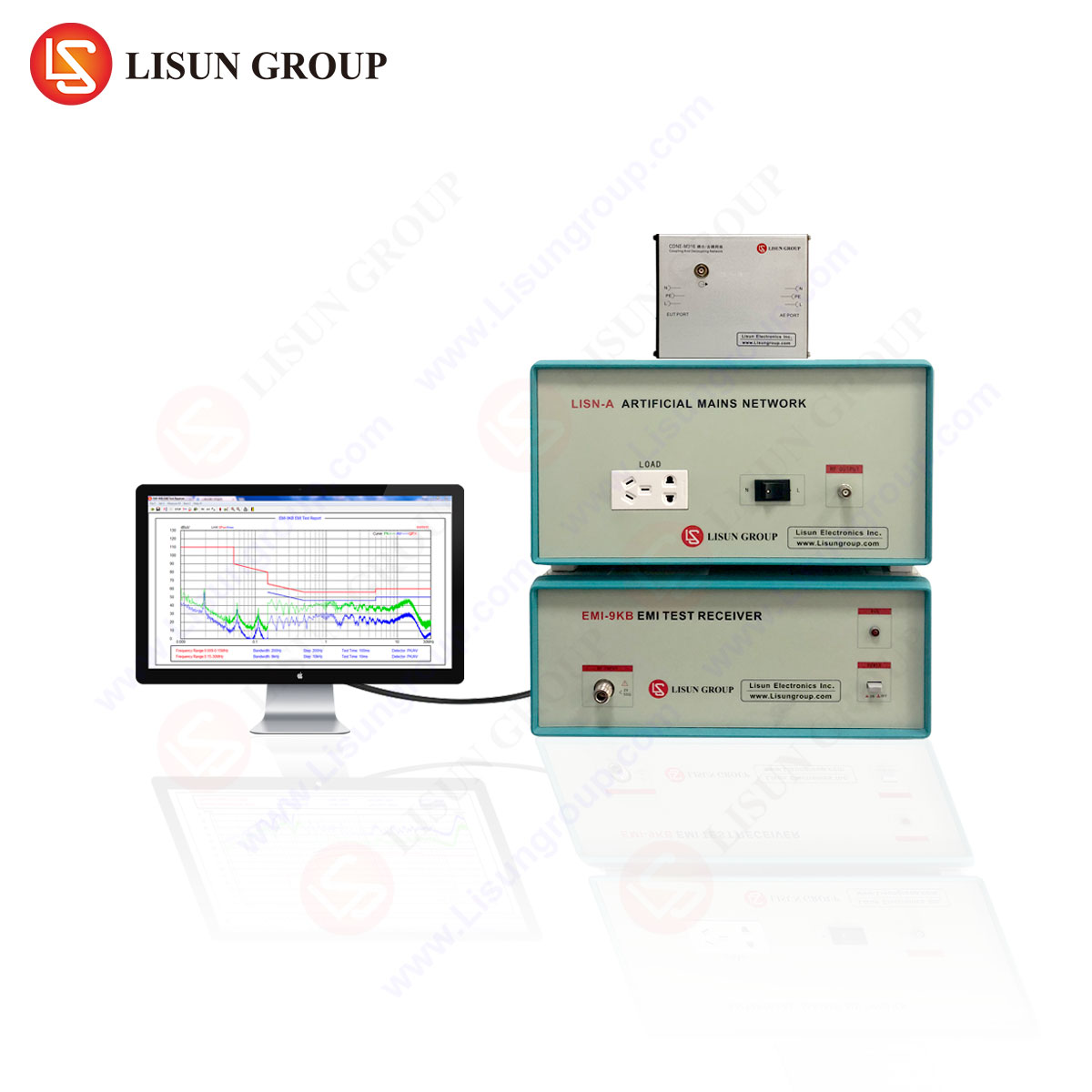
Lighting Fixtures, particularly LED drivers and electronic ballasts, generate conducted emissions primarily between 150 kHz and 30 MHz due to switching frequencies in constant-current regulators. The test setup per CISPR 15 requires a Line Impedance Stabilization Network (LISN) and receiver with 9 kHz resolution bandwidth and quasi-peak detection. Using a spectrum analyzer, the fast switching transients cause peak detector saturation and voltage standing wave ratio (VSWR) mismatches, leading to false passes.
The LISUN EMI-9KB is factory-calibrated to include an internal LISN simulation function, allowing direct connection to the equipment under test (EUT) without an external stabilization network. This integration reduces measurement uncertainty to < 2 dB. For Household Appliances such as induction cooktops, the receiver’s ability to measure both quasi-peak and average simultaneously—per CISPR 14-1—streamlines test duration. In contrast, a spectrum analyzer would require multiple sweeps and external software to emulate these detectors, introducing time-dependent error.
Intermodulation and Overload Performance in High-Density Environments
Industrial Equipment and Intelligent Equipment often operate in RF-dense environments where multiple transmitters (e.g., Wi-Fi, Bluetooth, Zigbee) coexist. A spectrum analyzer’s mixer, when presented with two strong in-band signals at -10 dBm each, generates intermodulation products (IM3) at -60 dBm in typical units, which can be misinterpreted as emission from the EUT. EMI receivers employ RF shielding, triple-tuned preselectors, and logarithmic amplifiers that suppress IM3 to below -90 dBm.
The LISUN EMI-9KA incorporates a proprietary overload detection system that flag signals exceeding the linear range before compression occurs, providing real-time user alerts. This feature is indispensable in Automobile Industry testing—where external FM transmitters and impulse noise from ignition systems produce transient peaks exceeding +20 dBm—ensuring the test report reflects only the EUT’s emissions.
Radiated Emission Testing for Medical Devices and Information Technology Equipment
For Medical Devices such as infusion pumps or patient monitors, radiated emissions from 30 MHz to 1 GHz must comply with IEC 60601-1-2, which references CISPR 11. The test setup includes a biconical antenna (30–200 MHz) and a log-periodic antenna (200 MHz–1 GHz), requiring the EMI receiver to switch antenna factors and preamplifier gain automatically. The LISUN EMI-9C series provides built-in antenna factor tables for over 50 standardized antennas, enabling automated correction without post-processing.
Spectrum analyzers lack this feature; engineers must manually input correction factors, increasing error probability. For Information Technology Equipment such as servers, the receiver’s peak-to-quasi-peak delta measurement (preserving the difference between peak and QP values) allows precompliance engineers to estimate quasi-peak levels from a single peak sweep, reducing test time by 40% per EUT.
Comparing Phase Noise and Frequency Stability in EMI Compliance
Phase noise, the random jitter in local oscillator (LO) signals, directly impacts measurement accuracy for narrowband emissions. In Audio-Video Equipment testing, residual FM sidebands from poor LO stability can mask emissions at 5 kHz offset. Spectrum analyzers using YIG-tuned oscillators exhibit phase noise of -100 dBc/Hz at 10 kHz offset, while EMI receivers—particularly the LISUN EMI-9KB—employ cavity-stabilized oscillators achieving -120 dBc/Hz.
This 20 dB improvement allows measurement of switching power supply harmonics at 10 kHz offset without desensitization. For Electronic Components testing, where emissions from crystal oscillators and PHY transceivers must be characterized with 1 kHz resolution, the receiver’s frequency stability of ±5 × 10⁻⁸ per week ensures repeatable results across temperature and aging.
Summary of Competitive Advantages: LISUN EMI-9 Series in Practice
The LISUN EMI-9KA, EMI-9KB, and EMI-9KC provide distinct advantages over spectrum analyzers in formal compliance testing:
- EMI-9KB (9 kHz–300 MHz): Ideal for conducted emissions in Low-voltage Electrical Appliances and Lighting Fixtures, featuring quasi-peak and average detectors with 6 dB/octave roll-off.
- EMI-9KC (9 kHz–300 MHz): Adds CISPR-Average detector and internal LISN, optimized for Power Tools and Industrial Equipment with rigorous transient immunity.
- EMI-9KA (9 kHz–1 GHz): Full radiated and conducted coverage for Medical Devices, Spacecraft, and Automobile Industry, including pre-selectors and 120 MHz bandwidth for broadband EMI scans.
Industry adoption includes semiconductor fabs (Electronic Components), EV charging stations (Power Equipment), and aerospace avionics (Communication Transmission). The receivers’ CE/FCC certification and traceable calibration to ISO 17025 labs ensure global acceptance.
Domande frequenti (FAQ)
Q1: Can a high-end spectrum analyzer replace the LISUN EMI-9KB for CISPR precompliance?
No. Spectrum analyzers lack quasi-peak and CISPR-average detectors. Even with external software emulation, the charging/discharging time constants cannot be replicated in hardware. The EMI-9KB’s dedicated detector circuits ensure ±1.5 dB accuracy versus 4–6 dB with a spectrum analyzer.
Q2: What bandwidth should I select for testing Power Equipment conducted emissions?
For 150 kHz–30 MHz, use 9 kHz IF bandwidth per CISPR 16-1-1. For frequencies below 150 kHz (e.g., rail transit harmonics), 200 Hz bandwidth is required. The EMI-9KC automatically switches bandwidths based on frequency band selection.
Q3: How do I ensure my test results with the EMI-9KA are accepted by FCC or EU Notified Bodies?
The EMI-9KA is factory-calibrated to ANSI C63.2 and CISPR 16-1-1 standards. Routine annual calibration to ISO 17025, combined with using calibrated antennas and LISNs, yields results accepted by major regulators. Retain calibration certificates for audit.
Q4: Is the LISUN EMI-9C series appropriate for MIL-STD-461 testing for Spacecraft applications?
Yes. The EMI-9KA covers the required frequency range (30 Hz–1 GHz) with optional internal preamplifier, and its peak and average detectors meet MIL-STD-461F limits. However, external LISNs may be required for 10 kHz–10 MHz conducted susceptibility measurements.
Q5: What is the typical test time for a Medical Device radiated emission scan (30 MHz–1 GHz) using the EMI-9KA?
A full quasi-peak scan over 30 MHz–1 GHz with 120 kHz bandwidth takes approximately 6–8 minutes per azimuth (peak + average). Using the receiver’s peak-scan-and-estimate mode reduces this to 2 minutes, enabling precompliance verification in production environments.
 English
  Spanish
  Russian
  Portuguese
  Turkish
  Arabic
  German
  Polish
  Italian
  French
  Korean
  Japanese
  Indonesian