




Introduction aux tests de décharge électrostatique (ESD)
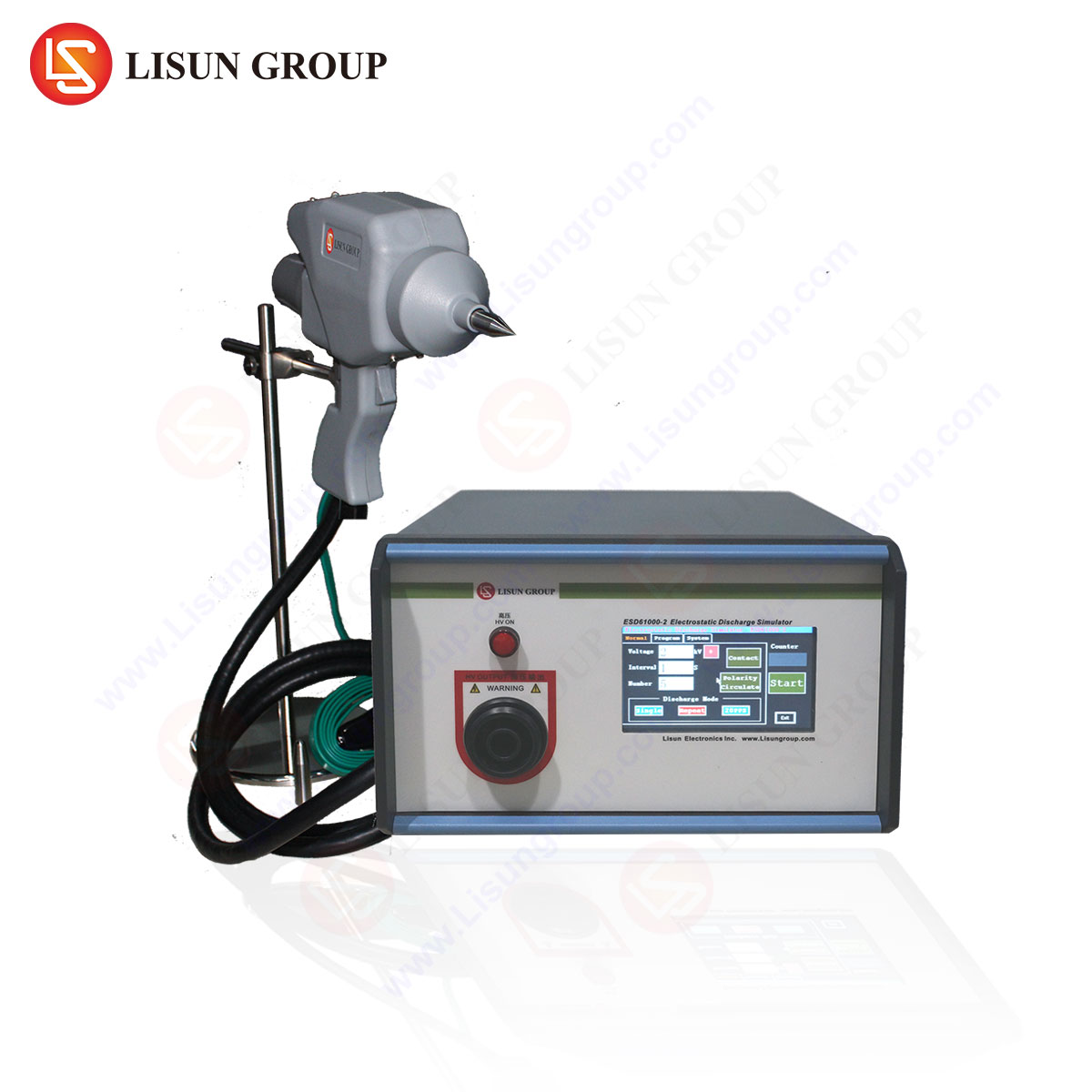
Electrostatic discharge (ESD) is a critical phenomenon in electronics manufacturing, where sudden current flows between objects at different electrostatic potentials can damage sensitive components. ESD guns, also known as ESD simulators, replicate these transient events to evaluate the immunity of electronic devices under standardized test conditions. This article examines the technical features of ESD guns, with a focus on the LISUN ESD61000-2, a high-precision instrument designed for compliance testing across multiple industries.
Core Functional Features of ESD Guns
High-Voltage Discharge Waveform Reproducibility
Le LISUN ESD61000-2 generates repeatable discharge waveforms in compliance with IEC 61000-4-2, ensuring accurate simulation of human-body model (HBM) ESD events. Key waveform parameters include:
- Temps de montée : 0.7–1 ns
- Peak Current: Up to 30 A (for 8 kV contact discharge)
- Discharge Modes: Contact and air discharge
This precision is essential for validating devices in sectors such as medical equipment et automotive electronics, where waveform fidelity impacts test reliability.
Adjustable Test Parameters for Multi-Standard Compliance
Le ESD61000-2 supports configurable voltage levels (0.1–30 kV) and discharge intervals (0.05–1 s), accommodating standards such as:
- IEC 61000-4-2 (General ESD immunity)
- ISO 10605 (Automotive ESD testing)
- ANSI/ESD STM5.1 (Component-level HBM testing)
This flexibility enables cross-industry applications, from household appliances to rail transit systems.
Principes et méthodologies d'essai
Direct and Indirect Discharge Modes
ESD testing involves two primary methodologies:
- Contact Décharge : A grounded tip directly injects current into the device under test (DUT).
- Décharge d'air : The ESD gun approaches the DUT until a spontaneous arc occurs, simulating real-world ESD events.
Le ESD61000-2 integrates both modes with automatic polarity switching (± polarity), critical for industrial equipment subjected to variable electrostatic environments.
Grounding and Environmental Controls
Proper grounding (≤ 1 Ω resistance) and humidity (30–60% RH) are mandated by IEC 61000-4-2 to minimize test variability. The ESD61000-2 includes a real-time environmental monitoring system, ensuring adherence to laboratory-grade conditions for aerospace et IT equipment validation.
Applications spécifiques à l'industrie
Medical Devices and Patient Safety
ESD-induced failures in defibrillators ou infusion pumps can have life-threatening consequences. The ESD61000-2’s ±15 kV air discharge capability verifies compliance with IEC 60601-1-2, mitigating risks in clinical environments.
Automotive Electronics and ISO 10605
Modern vehicles integrate sensitive ADAS sensors et infotainment systems. Les ESD61000-2’s 30 kV range exceeds ISO 10605’s 25 kV requirement, ensuring robustness against high-energy discharges in electric vehicle powertrains.
Consumer Electronics and IEC 61000-4-2
Pour smart home devices et audio-visual equipment, le ESD61000-2’s 150 pF / 330 Ω network replicates human-body discharges, identifying vulnerabilities in PCB layouts or shielding.
Avantages concurrentiels de LISUN ESD61000-2
Enhanced Accuracy with Digital Feedback Control
Unlike analog-based competitors, the ESD61000-2 employs closed-loop digital control, reducing waveform distortion (< ±5% deviation). This is critical for instrumentation manufacturers requiring sub-nanosecond timing precision.
Modular Design for Custom Test Setups
Interchangeable tips (4 mm round, 8 mm hemispherical) and remote triggering support integration into automated test systems for high-volume production lines in LED lighting et power tools.
Compliance with Emerging Standards
Le ESD61000-2 pre-validates against draft revisions of AEC-Q200 (passive components) and MIL-STD-883 (military-grade ESD), future-proofing R&D investments.
Spécifications techniques du LISUN ESD61000-2
| Paramètre | Spécification |
|---|---|
| Plage de tension | 0.1–30 kV (± polarity) |
| Modes de décharge | Contact / Air (automatic detection) |
| Conformité de la forme d'onde | IEC 61000-4-2, ISO 10605 |
| Temps de montée du courant | 0.7–1 ns |
| Environmental Monitoring | Built-in RH/temperature sensors |
| Interfaces | RS-232, Ethernet (remote control) |
Foire aux questions (FAQ)
Q1: How does the ESD61000-2 ensure consistent air discharge distances?
The gun’s motorized approach system maintains a 1 mm/s advance rate, eliminating manual errors per IEC 61000-4-2 Clause 6.2.
Q2: Can the ESD61000-2 test insulated devices?
Yes, indirect discharge via horizontal coupling planes (HCP/VCP) evaluates non-conductive enclosures in household appliances.
Q3: What industries mandate ESD61000-2 testing?
Medical (IEC 60601), automotive (ISO 10605), and telecom (EN 55035) sectors require it for CE/FCC certification.
Q4: How is waveform accuracy verified?
Third-party calibration using a 1 GHz oscilloscope and current target (per IEC 61000-4-2 Annex A).
Q5: Does the ESD61000-2 support non-standard pulse shapes?
Custom waveforms (e.g., 500 pF/500 Ω for spacecraft components) are programmable via PC software.
 English
  Spanish
  Russian
  Portuguese
  Turkish
  Arabic
  German
  Polish
  Italian
  French
  Korean
  Japanese
  Indonesian