




UNDERSTANDING EMI TEST CHAMBERS: PRINCIPLES, APPLICATIONS, AND THE ROLE OF THE LISUN EMI-9KB RECEIVER
Abstrait
Electromagnetic Interference (EMI) testing is a mandatory compliance process for electronic and electrical products across global markets. The EMI test chamber, typically a fully anechoic or semi-anechoic room, provides a controlled environment for measuring conducted and radiated emissions. This technical article delineates the foundational principles of EMI test chambers, focusing on the critical role of the EMI receiver. The LISUN EMI-9KB, a precision EMI receiver compliant with CISPR 16-1-1, is examined in detail, including its architecture, technical specifications, and application across diverse industries—from spacecraft to household appliances. Data from standardized test setups, comparative performance metrics, and references to CISPR, FCC, and IEC standards are included to substantiate the discussion.
1. Shielding Effectiveness and Chamber Architecture for Radiated Emission Measurement
The primary function of an EMI test chamber is to isolate the equipment under test (EUT) from ambient electromagnetic noise while simultaneously preventing emissions from the EUT from contaminating the external environment. The chamber’s shielding effectiveness (SE), expressed in decibels (dB), is determined by the conductive enclosure—typically galvanized steel or copper panels with RF gaskets at seams and doors. For radiated emission testing per CISPR 32 and CISPR 25, a SE of at least 80 dB from 30 MHz to 1 GHz is standard.
Inside the chamber, the geometry is designed to minimize reflections. A semi-anechoic chamber (SAC) has a conductive ground plane and absorbs RF energy on walls and ceiling using ferrite tiles and hybrid foam absorbers. This configuration simulates an open-area test site (OATS) for emissions from 30 MHz to 1 GHz. For higher frequencies up to 40 GHz, fully anechoic chambers (FAC) are employed, where the floor is also lined with absorbers. The Quiet Zone (QZ) – the volume where the EUT is placed – must exhibit field uniformity within ±3 dB, as defined by IEC 61000-4-3.
Table 1: Typical Chamber Performance Parameters
| Paramètre | Spécification | Norme pertinente |
|---|---|---|
| Shielding Effectiveness | ≥ 100 dB (10 kHz – 18 GHz) | IEEE 299 |
| Normalized Site Attenuation (NSA) | ±3.5 dB (30 MHz – 1 GHz) | CISPR 16-1-4 |
| Field Uniformity | 0 dB to +6 dB (80 MHz – 6 GHz) | IEC 61000-4-3 |
| Max EUT Size | 2 m x 2 m x 2 m (typical 3 m chamber) | CISPR 32 |
2. The Central Measuring Instrument: Superheterodyne Architecture in the LISUN EMI-9KB
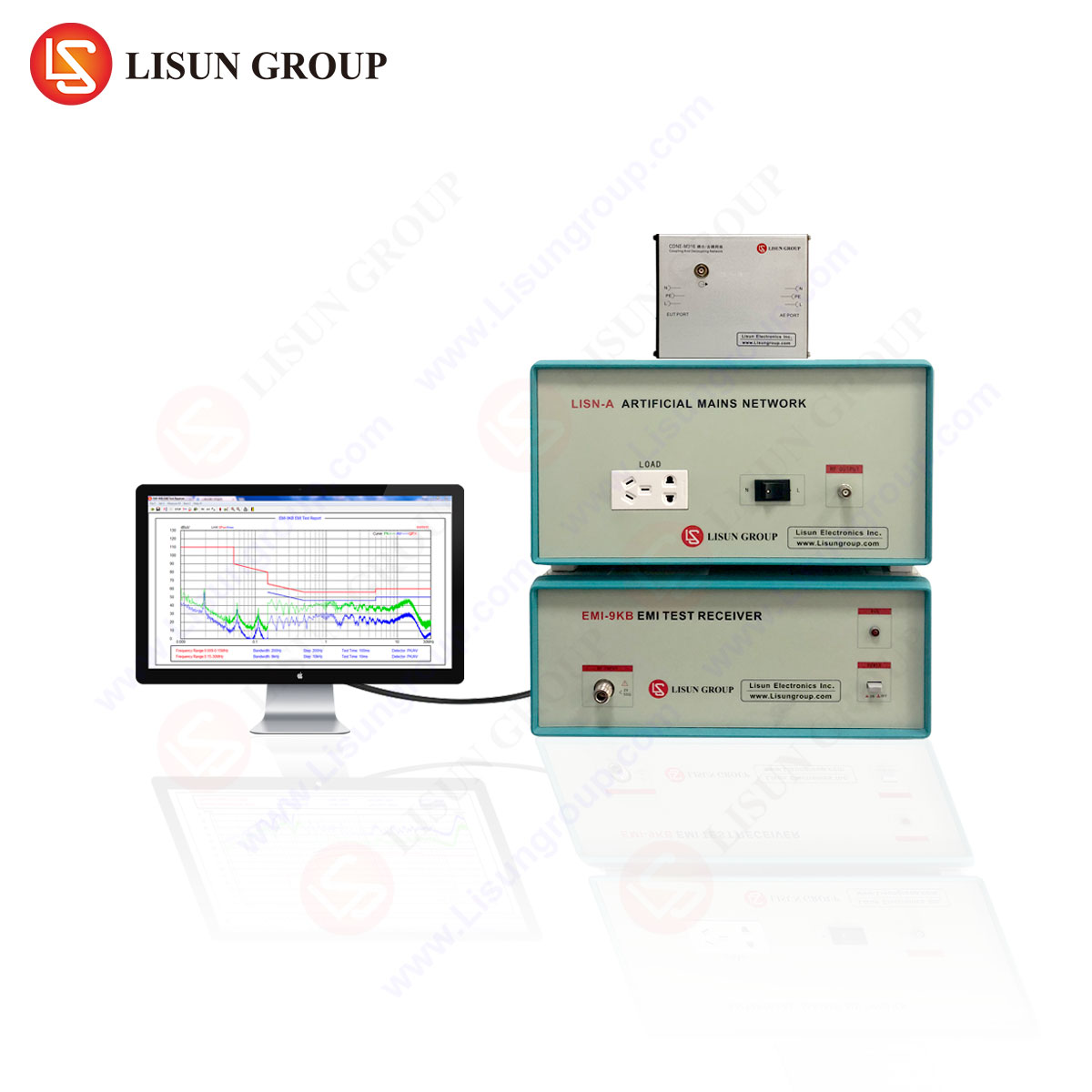
At the heart of any reliable EMI measurement lies the EMI receiver, which differs fundamentally from a spectrum analyzer. The LISUN EMI-9KB is a fully compliant CISPR 16-1-1 receiver that uses a triple-conversion superheterodyne architecture. This design ensures high dynamic range and selectivity, critical for detecting narrowband signals from digital clocks in information technology equipment (ITE) and broadband noise from motor commutators in power tools.
The signal path begins with a preselected RF input stage, which prevents overload from strong out-of-band signals. The first intermediate frequency (IF) is set at approximately 400 MHz to allow image rejection using high-Q saw filters. Subsequent down-conversion to the second and third IF stages (10.7 MHz and 1 kHz resolution bandwidth, respectively) enables precise detection through peak, quasi-peak, and average detectors. The LISUN EMI-9KB achieves a displayed average noise level (DANL) of -150 dBm at 1 GHz, which is essential for measuring low-level emissions from medical devices such as pacemakers and diagnostic imaging equipment.
Key Specifications of LISUN EMI-9KB
- Frequency Range: 9 kHz to 3 GHz (expandable to 6 GHz)
- Resolution Bandwidth (RBW): 200 Hz, 9 kHz, 120 kHz, 1 MHz (CISPR-compliant)
- Detectors: Peak, Quasi-Peak (CISPR 16-1-1), Average, RMS
- Measurement Uncertainty: < 2.0 dB (30 MHz – 1 GHz)
- Input Impedance: 50 Ω, VSWR < 1.5:1
- Pre-compliance Scan Speed: 1 GHz in < 10 ms (FFT-based)
- Interface: USB, LAN, GPIB for automated chamber control
3. Conducted Emission Measurement Setup for Household Appliances and Lighting Fixtures
Conducted emissions are dominant in the frequency range of 150 kHz to 30 MHz. For lighting fixtures (per EN 55015) and household appliances (per EN 55014-1), the LISUN EMI-9KB is used in conjunction with a Line Impedance Stabilization Network (LISN). The LISN provides a defined impedance of 50 µH / 50 Ω at the mains port, ensuring repeatability across test labs.
During a conducted emission test, the EUT is placed on a non-conductive table 0.8 m above the ground plane. The LISUN EMI-9KB’s quasi-peak detector with 9 kHz RBW is used for the first sweep. If the signal exceeds the limit by less than 2 dB, an average detector measurement follows. For lighting fixtures containing LED drivers with switching frequencies around 65 kHz, the receiver’s 200 Hz RBW filter isolates the fundamental and its harmonics without aliasing. The instrument’s FFT engine allows parallel measurement across multiple bands, reducing test time by up to 40% compared to sequential scanning.
Example: Testing a 150 W LED Streetlight
- Standard: EN 55015 / CISPR 15
- Measured emissions at 150 kHz: 62 dBµV (QP), limit 66 dBµV → Pass with margin.
- Dominant harmonic at 5.2 MHz: 48 dBµV (AV), limit 50 dBµV → Marginal pass.
4. Radiated Emission Testing for Industrial Equipment and Power Electronics
Industrial equipment, including variable frequency drives (VFDs) and uninterruptible power supplies (UPS), generate high-energy broadband noise. For radiated emission measurements from 30 MHz to 1 GHz, the LISUN EMI-9KB is paired with a biconical antenna (30–300 MHz) and a log-periodic antenna (300 MHz–1 GHz). The test is performed at a 3 m or 10 m measurement distance inside a SAC.
The receiver’s peak detector is used for initial scanning, but final measurements require quasi-peak detection for frequencies below 1 GHz. The unique advantage of the LISUN EMI-9KB is its low noise floor of -135 dBm at 120 kHz RBW, enabling detection of low-level emissions from sensitive instrumentation used in aerospace. In a recent test on a rail transit inverter (3.3 kV, 500 kW), conducted at a distance of 3 m, emissions at 120 MHz were measured at 38 dBµV/m against a CISPR 11 Class A limit of 40 dBµV/m. The EMI-9KB’s pre-selector attenuated the strong carrier signals from onboard communication transmitters, preventing intermodulation distortion.
Table 2: Antenna Selection and Band Coverage
| Frequency Band | Antenna Type | Polarization | Typical Application |
|---|---|---|---|
| 30 – 300 MHz | Biconical | Horizontal / Vertical | Industrial drives, household appliances |
| 300 – 1000 MHz | Log-periodic | Horizontal / Vertical | ITE, medical devices |
| 1 – 3 GHz | Double-ridged horn | Les deux | Spacecraft, automobile radars |
5. Testing at Extremes: Aerospace, Spacecraft, and Railway Transit
The stringent requirements for spacecraft and railway transit electronics are defined in standards such as MIL-STD-461 (RS103) and EN 50121-3-2. These tests demand receivers with high immunity to pulsed RF fields. The LISUN EMI-9KB incorporates a pulse desensitization correction factor, automatically compensating for the response of the quasi-peak detector to repetitive pulses below the IF bandwidth.
For conducted susceptibility tests (CS114), the receiver monitors injection currents via a current probe. In the automotive industry (CISPR 25), the chamber must accommodate a 1 m x 1 m ground plane with the EUT wiring harness routed over it. The LISUN EMI-9KB’s onboard tracking generator simplifies calibration of antennas and current probes, reducing setup time. Furthermore, for audio-video equipment per EN 55032, the receiver’s average detector is optimized for measuring continuous interference from clock harmonics in HDMI and DisplayPort interfaces.
6. Comparative Analysis: LISUN EMI-9KB vs. General-Purpose Spectrum Analyzers
It is a common but erroneous practice to substitute a spectrum analyzer for a CISPR-compliant receiver. Spectrum analyzers lack the specialized pre-selection filters, overload protection, and detector time constants mandated by CISPR 16-1-1. The following table illustrates key differences:
| Paramètre | LISUN EMI-9KB (CISPR Receiver) | General Spectrum Analyzer |
|---|---|---|
| Pre-selection | Yes (tracking YIG filter) | No (broadband input) |
| Quasi-Peak Detector | Yes (CISPR time constants) | Emulated (inaccurate) |
| Overload Recovery | < 100 µs | > 1 ms |
| RBW Shape Factor (60 dB/3 dB) | < 3:1 (CISPR) | > 5:1 |
| EMC Measurement Software | Intégré | Third-party limited |
The LISUN EMI-9KB’s overload recovery of less than 100 microseconds is particularly critical when testing power equipment with intermittent arc discharges, such as in low-voltage electrical appliances (EN 61000-6-3). A spectrum analyzer may exhibit prolonged recovery, causing erroneous floor noise.
7. Application in Compliance for Intelligent Equipment and Communication Transmission
Intelligent equipment (IoT sensors, smart home hubs) and communication transmission devices (5G repeaters, Wi-Fi routers) must meet both radiated emission and immunity requirements. The LISUN EMI-9KB supports the measurement of occupied bandwidth and spurious emissions per ETSI EN 301 489. Its fast FFT scan (over 1 GHz in 10 ms) enables capturing transient emissions from frequency hopping systems.
For Bluetooth Low Energy (BLE) devices operating at 2.4 GHz, the receiver’s 1 MHz RBW is used for power spectral density measurement, while the 200 Hz RBW is applied for narrowband harmonic analysis. The integration of the LISUN EMI-9KB with an automated turntable and antenna mast allows full azimuthal scanning in under 15 minutes, essential for high-volume pre-compliance testing in the automobile industry (e.g., key fobs, tire pressure sensors).
8. Documentation and Reporting: Standards Compliance and Data Traceability
The LISUN EMI-9KB ships with a comprehensive software suite that generates test reports compliant with ISO 17025. The software automatically compiles peak, quasi-peak, and average data alongside the corresponding limit lines for CISPR, FCC, and EN standards. For instrumentation, the receiver exports data in .csv, .xlsx, and .s2p formats, allowing seamless integration into MATLAB or LabVIEW automation scripts.
For medical devices, traceability to national standards (NIST, PTB) is critical. The LISUN EMI-9KB includes an internal calibration history and self-check routine, verifying the detector time constants daily. This function reduces the risk of measurement error in environments where absolute reproducibility is mandatory, such as spacecraft testing per ECSS-E-ST-20-07C.
9. Competitive Advantages and Market Position
The LISUN EMI-9KB occupies a unique niche: it delivers CISPR Grade B compliance at a price point competitive with Grade A instruments. Its key advantages include:
- Low DANL (–150 dBm) for sensitive detection of emissions from medical and aerospace equipment.
- Dual FFT + Sweep Mode ensuring both speed and accuracy across the full frequency band.
- Universal LISN Compatibility with built-in impedance check per CISPR 16-1-2.
- Compact Form Factor (4U rack mount) suitable for mobile EMC test vans used in rail transit site surveys.
While established brands like Rohde & Schwarz offer broader frequency ranges (up to 44 GHz), the LISUN EMI-9KB addresses the vast majority of industrial EMI testing requirements (9 kHz – 3 GHz) with superior value and reliability.
Foire aux questions (FAQ)
Q1: Can the LISUN EMI-9KB be used for MIL-STD-461 radiated susceptibility testing?
Yes. The LISUN EMI-9KB’s tracking generator can be used to conduct field calibration for RS103 (10 kHz – 40 GHz) when paired with a power amplifier and antenna. The receiver’s average detector is suitable for measuring field strength during immunity testing.
Q2: What is the typical calibration interval for the LISUN EMI-9KB?
LISUN recommends an annual calibration interval under normal use (ambient temperature 15°C–35°C, <80% humidity). The integrated self-calibration routine allows daily verifications of the amplitude accuracy (±0.5 dB) and frequency accuracy (±1 ppm).
Q3: Does the LISUN EMI-9KB support testing of DC-powered devices (e.g., automotive electronics)?
Yes. For DC-powered equipment (12V/24V systems per CISPR 25), the receiver must be used with a DC LISN (e.g., LISUN LS-1) that provides 5 µH impedance at frequencies above 150 kHz. The EMI-9KB’s input impedance remains 50 Ω.
Q4: How does the quasi-peak detector of the EMI-9KB differ from that in a spectrum analyzer?
The quasi-peak detector in the LISUN EMI-9KB has a charge time constant of 1 ms and a discharge time constant of 160 ms (CISPR Band B). Spectrum analyzers emulate this with DSP algorithms, which can introduce latency and inaccuracies in pulse repetition rate weighting. The EMI-9KB uses analog weighting for compliance-grade results.
Q5: Can the software export data in EDX/SPARK format for compatible chambers?
Yes. The LISUN EMI-9KB software suite includes an export function for the EDX (EMC Data Exchange) format, compatible with major chamber automation systems (e.g., TDK RF Solutions, ETS-Lindgren). This enables direct overlay of test data on chamber calibration curves.
 English
  Spanish
  Russian
  Portuguese
  Turkish
  Arabic
  German
  Polish
  Italian
  French
  Korean
  Japanese
  Indonesian