




Introduction to High-Precision Luminance Measurement
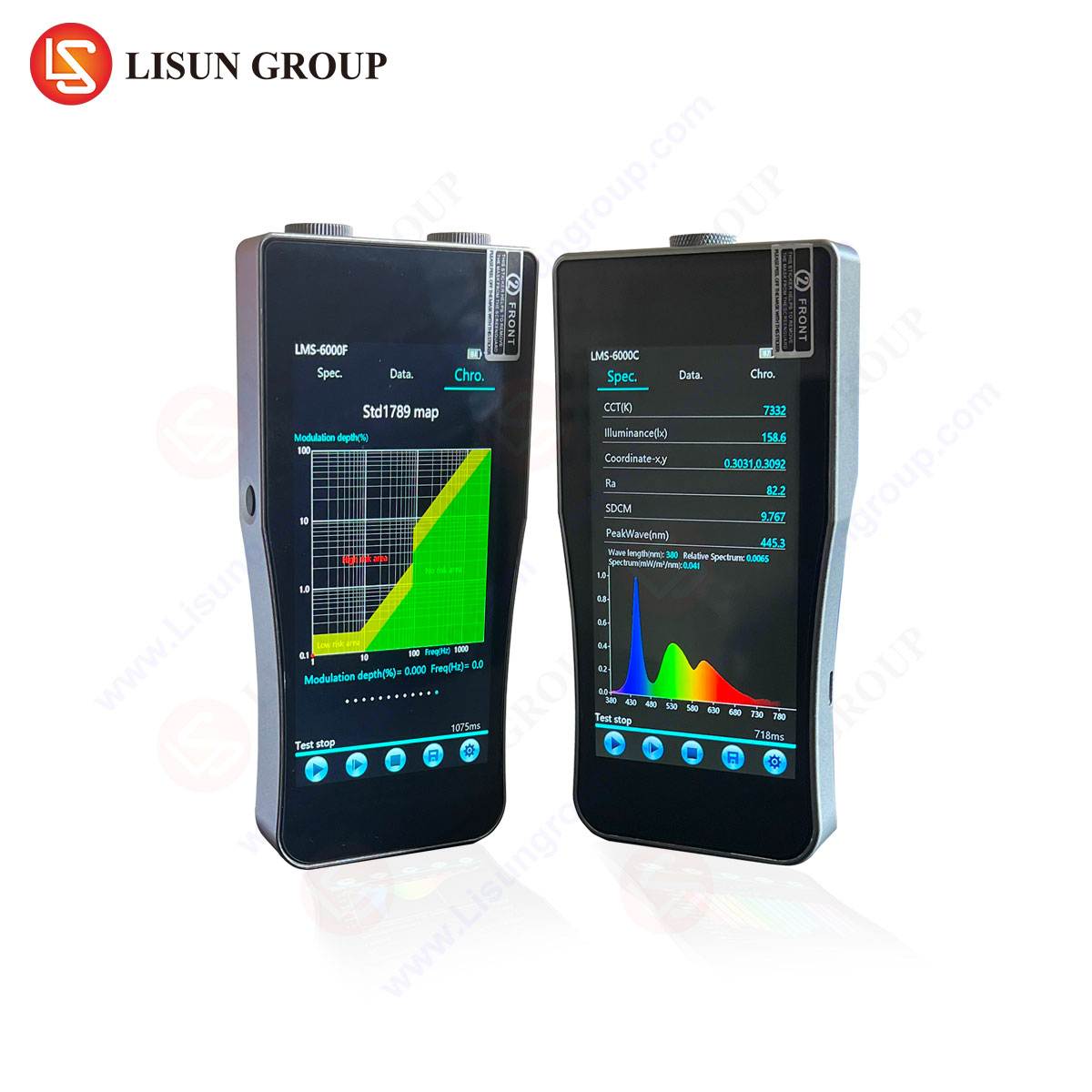
Accurate luminance measurement is critical across multiple industries, from automotive lighting to display manufacturing. The LISÚN Serie LMS-6000 represents a state-of-the-art solution for professionals requiring precise photometric and radiometric analysis. This article examines the LMS-6000F, a specialized variant optimized for fast-response luminance testing in dynamic lighting environments.
Technical Specifications of the LMS-6000F
El LMS-6000F is engineered for high-speed luminance measurement with exceptional accuracy. Key specifications include:
| Parámetro | Value |
|---|---|
| Rango de luminancia | 0.01–300,000 cd/m² |
| Gama espectral | 380–780 nm |
| Exactitud | ±2% (calibrated to NIST standards) |
| Velocidad de medición | Up to 1000 samples per second |
| Campo de visión | 1°–5° (adjustable) |
| Interfaz de datos | USB, Bluetooth, RS-232 |
The device employs a high-sensitivity CCD sensor paired with a precision optical system, ensuring repeatability in both laboratory and industrial settings.
Measurement Principles and Calibration Methodology
El LMS-6000F operates on the principle of spectroradiometric luminance analysis, capturing light intensity per unit solid angle (candela per square meter). Key methodologies include:
- Spectral Matching Correction: Ensures alignment with CIE 1931 standard observer functions.
- Dynamic Range Optimization: Adaptive exposure control prevents saturation in high-luminance conditions.
- Temperature Compensation: Built-in thermal regulation minimizes drift in fluctuating environments.
Calibration follows ISO/CIE 19476 y ANSI C78.377 standards, with traceability to NIST-certified reference sources.
Industry Applications of the LMS-6000F
Pruebas de iluminación automotriz
El LMS-6000F evaluates headlamps, taillights, and dashboard displays for compliance with ECE R48 y FMVSS 108 regulations. Its high-speed sampling captures transient effects in LED turn signals and adaptive driving beam (ADB) systems.
Fabricación de LED y OLED
In production lines, the device verifies luminance uniformity and color consistency of panels, ensuring adherence to IEC 62931 y Energy Star V3.0 requisitos.
Iluminación aeroespacial y de aviación
The instrument tests cockpit displays and runway lighting for FAA and EASA compliance, with ruggedized housing for vibration resistance.
Pruebas de equipos de visualización
Used for QA validation of LCD, OLED, and microLED screens, measuring mura defects and angular luminance shifts per VESA DisplayHDR 1400.
Diseño de iluminación urbana
Municipalities deploy the LMS-6000F to optimize streetlight uniformity, minimizing glare while meeting EN 13201 roadway lighting standards.
Competitive Advantages Over Conventional Luminance Meters
- High-Speed Sampling: 1000 Hz refresh rate outperforms traditional photometers (typically < 100 Hz).
- Cumplimiento de múltiples normas: Preloaded with CIE, ISO, and ANSI test protocols.
- Modular Optics: Interchangeable lenses adapt to narrow-field (1°) or wide-field (5°) applications.
- Real-Time Data Logging: Integrated software (LSR-6000) supports CSV and JSON export for automated reporting.
Scientific Research and Photometric Standards
El LMS-6000F is referenced in peer-reviewed studies for:
- Retinal hazard assessment (ANSI/IESNA RP-27).
- Photobiological safety (IEC 62471).
- Solar simulator validation (ASTM E927).
A 2023 study in Optics Express demonstrated its use in quantifying circadian-effective irradiance for medical lighting design.
FAQ: Common Technical Queries
Q1: How does the LMS-6000F handle ambient light interference?
The device employs a synchronized shutter and optical baffling to reject stray light, with optional dark-box calibration for low-luminance scenarios.
Q2: What is the recommended recalibration interval?
Annual recalibration is advised for laboratory-grade accuracy, though field applications may extend to 18 months with verification checks.
Q3: Can the LMS-6000F measure flicker in PWM-driven LEDs?
Yes, its high sample rate captures flicker percentages up to 10 kHz, per IEEE 1789-2015 guidelines.
Q4: Is the device compatible with automated test rigs?
The RS-232 and USB interfaces support integration into robotic arms or conveyor-based inspection systems.
Q5: What distinguishes the LMS-6000F from the LMS-6000UV variant?
The UV model extends spectral coverage to 365 nm for UV curing validation, whereas the 6000F prioritizes speed for dynamic lighting tests.
This article underscores the LMS-6000F as an indispensable tool for industries demanding rigorous photometric validation. Its fusion of precision, adaptability, and compliance ensures reliability in both R&D and mass production environments.
 English
  Spanish
  Russian
  Portuguese
  Turkish
  Arabic
  German
  Polish
  Italian
  French
  Korean
  Japanese
  Indonesian