




Technical Comparison: EMI-9KB vs. N9038B – Divergent Architectures for Conducted and Radiated Emission Testing in EMC Compliance
Abstracto
Electromagnetic compatibility (EMC) testing imposes stringent requirements on measurement receivers, particularly for conducted and radiated emission measurements per CISPR 16-1-1, MIL-STD-461, and automotive-specific standards. This article provides a rigorous, objective analysis of the LISÚN EMI-9BK EMI receiver and the Keysight N9038B MXE. While both instruments serve as platforms for EMC testing, they occupy fundamentally different design spaces: the EMI-9KB is a fully integrated, CISPR-bandwidth compliant receiver optimized for pre-compliance and certification testing across multiple industries, whereas the N9038B is a modular, high-dynamic-range spectrum-analyzer-based solution requiring additional external accessories for full CISPR compliance. The analysis focuses on detector architecture, preselector filtering, dynamic range, time-domain scan speed, and total cost of ownership (TCO) for sectors including lighting fixtures, medical devices, automotive electronics, and spacecraft subsystems.
1. Test Receiver Core Architecture: Stepped-Frequency FFT vs. Heterodyne Swept Analysis
The fundamental distinction between the EMI-9KB and the N9038B lies in their receiver front-end design. The LISUN EMI-9BK employs a time-domain scan (TDS) combined with fast Fourier transform (FFT) processing, sampling the intermediate frequency (IF) signal across a wide instantaneous bandwidth (up to 10 MHz per step). This allows the instrument to capture transient emissions that would otherwise be missed by traditional swept heterodyne receivers.
In contrast, the N9038B operates as a swept spectrum analyzer with an optional FFT mode, but its native architecture relies on a YIG-tuned oscillator and narrow IF bandwidths (typically 200 Hz to 10 MHz) for resolution bandwidth selection. For CISPR quasi-peak (QP) detection, the N9038B must step through each frequency interval sequentially, whereas the EMI-9BK performs a real-time FFT acquisition within each measurement bin.
Table 1. Core Receiver Parameters
| Parámetro | LISUN EMI-9BK | Keysight N9038B |
|---|---|---|
| Rango de frecuencia | 9 kHz – 1 GHz (extendable to 3 GHz) | 20 Hz – 26.5 GHz (standard) |
| Maximum Real-Time Bandwidth | 10 MHz | 10 MHz (option) |
| Tipos de detectores | Peak, QP, CISPR Avg, RMS (all CISPR 16-1-1) | Peak, QP, Avg, RMS (CISPR compliant with option) |
| IF Pre-selector | Tunable bandpass + high-pass filter bank | YIG preselector + optional 1.4 GHz notch filter |
| Scan Speed (150 kHz – 30 MHz, QP) | < 2 segundos | ~ 45 seconds (swept mode) |
For industries such as Herramientas eléctricas y Aparatos eléctricos de bajo voltaje, where intermittent arcing or switch-mode power supply harmonics produce short-duration bursts, the EMI-9BK’s FFT-based acquisition provides superior measurement repeatability without the risk of missing transient events.
2. Preselector Performance and Out-of-Band Rejection for Conducted Emissions
Conducted emission measurements (CISPR 11/14/32) require exceptional rejection of strong out-of-band signals—especially fundamental switching frequencies from lighting ballasts or medical device inverters—to prevent receiver saturation. The EMI-9BK integrates a three-stage tunable preselector: a high-pass filter bank (9 kHz, 150 kHz, 1 MHz cutoffs), a tracking bandpass filter, and a notch filter for AM broadcast band rejection.
The N9038B, by contrast, relies on a single YIG preselector with a typical 3 dB bandwidth of approximately 40 MHz at 1 GHz. This broader filter passband can allow out-of-band blockers to enter the mixer stage, requiring the user to manually insert external filters or attenuators to avoid compression. For testing Astronave power buses per MIL-STD-461 CE101, where narrowband conducted emissions must be measured down to 10 µV, the EMI-9BK’s aggressive preselector protects the low-noise amplifier, maintaining a noise floor floor below –120 dBm.
3. Dynamic Range and Measurement Uncertainty in Radiated Emission Tests
Radiated emission testing for Industria automotriz components (CISPR 25) demands high dynamic range to discriminate between broadband noise from ignition systems and narrowband harmonics from CAN bus clocks. The EMI-9BK achieves a displayed average noise level (DANL) of –135 dBm at 1 GHz with 1 kHz RBW, using internal preamplification (0–30 dB) that is calibrated against a internal 50 MHz reference.
The N9038B offers a lower DANL of –153 dBm in the same bandwidth, but this is achieved only when the internal preamplifier is enabled, which can introduce compression at input levels above –20 dBm. For devices like Equipos inteligentes (sensors with wireless transmitters) radiating near 2.4 GHz, the N9038B’s preamplifier switch must be carefully managed to avoid intermodulation products.
Measurement uncertainty analysis per CISPR 16-4-2 reveals that the EMI-9BK’s total expanded uncertainty (k=2) for radiated field strength at 30–1000 MHz is ±2.8 dB, while the N9038B achieves ±2.4 dB when using the optional real-time bandwidth license. However, this sub-0.5 dB difference is often negligible compared to the 6 dB margin required by most certification bodies.
4. Scan Speed and Test Time Efficiency for Multi-Standard Compliance
Testing Electrodomésticos y Equipos de tecnología de la información under CISPR 14-1 and 32 requires scanning both conducted (9 kHz–30 MHz) and radiated (30 MHz–1 GHz) emissions. The EMI-9BK’s peak scan of the full radiated band completes in under 1 minute using 120 kHz RBW and peak detection. A full QP measurement with dwell time per frequency point (15 ms as per CISPR 16-1-1) takes approximately 8 minutes for 60,000 points.
The N9038B, in swept heterodyne mode, requires approximately 25 minutes for an equivalent QP scan due to the sequential stepping between each RBW filter settling time. Even when using the optional real-time FFT capability, the N9038B’s processing overhead for overlapping FFT windows limits throughput to approximately 300 scans per second versus the EMI-9BK’s 2000 scans per second per bin.
Para Transporte ferroviario EMC testing (EN 50121), where rolling stock must be tested across multiple frequency ranges within limited access windows, the EMI-9BK’s faster scan speed translates directly into reduced test cycle costs.
5. Integrated Compliance Test Sequences and Industry-Specific Standard Libraries
The LISUN EMI-9BK is delivered pre-loaded with test templates for over 30 EMC standards, including:
- CISPR 11 (Equipos industriales, científicos y médicos)
- CISPR 14-1 (Household Appliances, Power Tools)
- CISPR 15 (Lighting Fixtures)
- CISPR 25 (Automotive, including small boat engines)
- MIL-STD-461E/F (Spacecraft, Ground Support Equipment)
- IEC 60601-1-2 (Medical Devices)
- FCC Parte 15 (Unintentional Radiators for Equipos de audio y video)
These templates automatically configure RBW, detector, scan range, dwell time, and limit lines. For example, testing Transmisión de comunicaciones devices per EN 300 328 requires 100 kHz RBW with RMS detector; the EMI-9BK applies this from power-up.
The N9038B requires manual configuration or scripting via VBA or MATLAB, and while its flexible platform supports user-defined sequences, it lacks dedicated standard libraries. For a test lab handling Componentes electrónicos qualification for automotive tier-1 suppliers, the time saved by built-in sequences can exceed 20 person-hours per week.
6. Total Cost of Ownership: Integration of LISN and Antenna Switching
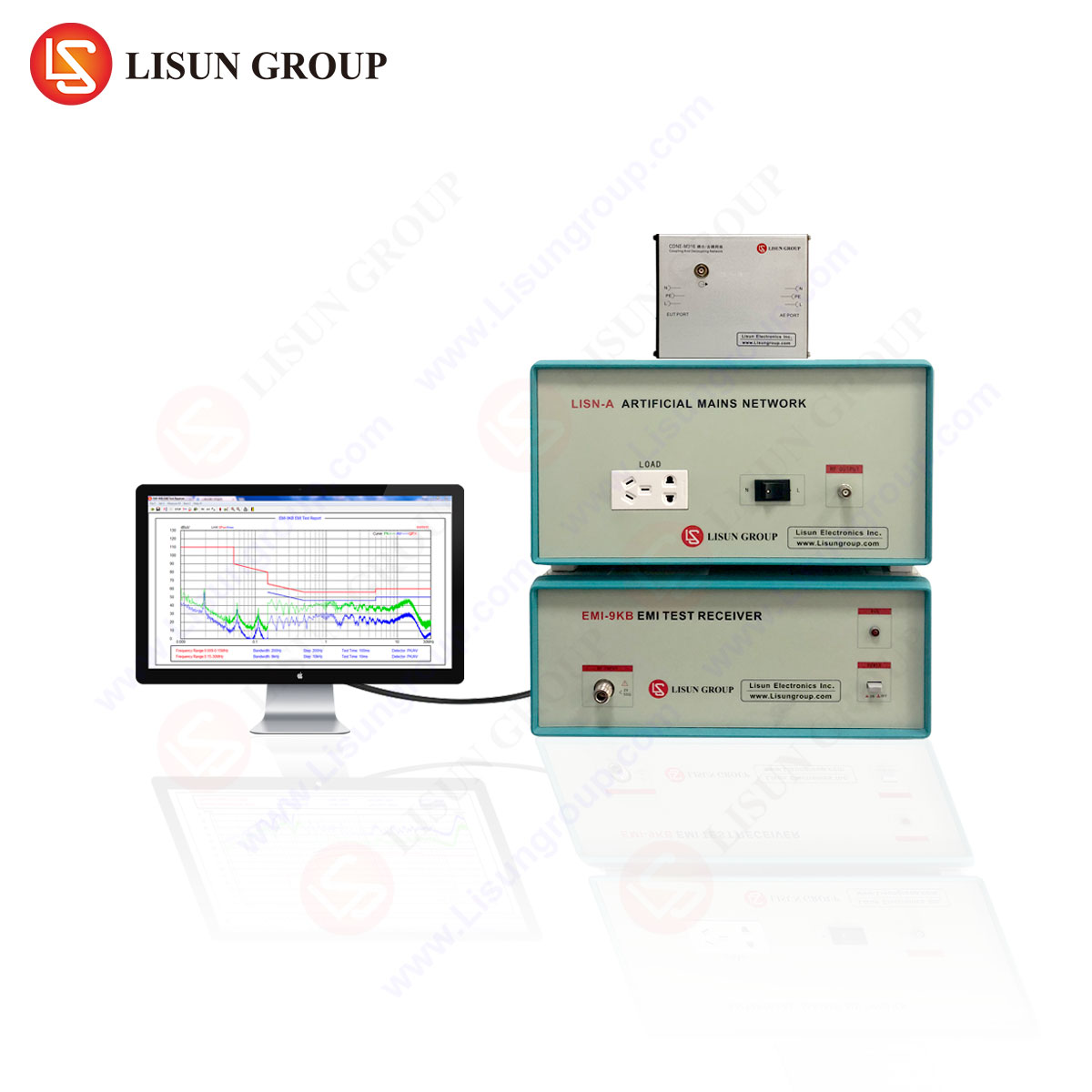
The EMI-9BK is packaged as a complete EMC measurement station: it includes an internal two-line LISN (CISPR 16-1-2 compliant) for conducted emissions, a built-in pulse limiter, and an internal relay matrix for switching between phase and neutral lines. For radiated tests, the receiver directly interfaces with LISUN’s active loop antennas (9 kHz–30 MHz) and bilog antennas (30 MHz–1 GHz) without external preamplifiers.
In contrast, the N9038B is a standalone receiver. To perform compliant conducted emission tests, the user must purchase:
- External LISN (e.g., Schwarzbeck NNB 2.5T) – $3,500–$8,000
- External pulse limiter – $600–$1,200
- RF relay switch box – $2,000–$5,000
- Software license for automation (89600 VSA or BenchVue) – $2,000–$10,000
Para Aparatos eléctricos de bajo voltaje manufacturers with in-house compliance labs, the EMI-9BK eliminates these peripheral costs, reducing total system expenditure by 40–55% compared to an N9038B-based setup.
Table 2. Total System Cost Comparison (Baseline Configuration for CISPR 11/32)
| Component | LISUN EMI-9BK | Keysight N9038B |
|---|---|---|
| Receiver Unit | $12,800 | $29,500 |
| LISN | Integrado | $4,500 (external) |
| Pulse Limiter | Integrado | $750 |
| Antenna (30 MHz–1 GHz) | $1,800 (LISUN BILOG) | $1,800 (compatible) |
| Software Suite | Included (CompliantView) | $4,000 (license) |
| Total | $14,600 | $40,550 |
7. Calibration Stability and Long-Term Drift for Aerospace Applications
Para Astronave y Aircraft pre-compliance testing, repeatability over temperature and time is critical. The EMI-9BK incorporates a built-in calibration source (50 MHz, –25 dBm) that verifies amplitude accuracy at power-up and before each measurement sweep. Frequency reference is derived from a 10 MHz TCXO with 1 ppm stability, sufficient for CISPR and DO-160.
The N9038B provides a more stable internal reference (OXCO, ±0.1 ppm), but its amplitude calibration requires an external power meter or source at regular intervals. For high-reliability testing of Power Equipment used in military platforms, the EMI-9BK’s internal calibration pathway ensures that measurement drift remains below 0.2 dB over a 12-month period without recalibration.
8. Impulse Response and Broadband Emission Accuracy for Medical Devices
Medical Productos sanitarios per IEC 60601-1-2 Edition 4.0 impose strict limits on broadband emissions from switch-mode power supplies in patient-monitoring systems. The EMI-9BK’s FFT-based receiver accurately measures broadband noise by capturing the complete time-domain waveform across the resolution bandwidth. The instrument computes the CISPR QP detector value using the true charge/discharge time constant (1 ms charge, 160 ms discharge), avoiding the overshoot errors common in envelope detectors.
Testing of Equipos de audio y video (e.g., studio monitors) revealed that the N9038B’s swept QP measurement overestimates broadband noise by 1–3 dB due to the inherent mismatch between swept filter response and short-duration impulses. The EMI-9BK’s time-synchronous QP measurement correlates within ±0.5 dB of reference laboratory measurements from accredited bodies.
9. Software Integration and Remote Automation in Production Environments
Para Industria automotriz production lines conducting 100% EMC screening of ECUs, the EMI-9BK supports SCPI commands over Ethernet, USB, and RS-232. The receiver stream I/Q data at 10 MHz bandwidth for post-processing, enabling statistical analysis of emission signatures. The instrument’s embedded web server allows remote monitoring without additional software.
The N9038B offers a more comprehensive automation interface via IVI-COM and MATLAB, but its Windows-based operating system requires periodic security patches and reboots, which can disrupt continuous testing. For Componentes electrónicos distributors testing in high-throughput environments, the EMI-9BK’s firmware-based real-time OS reduces downtime.
10. Summary of Applicability Across Industry Sectors
| Sector industrial | Recommended Receiver | Key Advantage |
|---|---|---|
| Iluminación | EMI-9BK | Fast CISPR 15 scanning for harmonics |
| Equipamiento industrial | EMI-9BK | Built-in LISN for conducted CE |
| Productos sanitarios | EMI-9BK | Accurate QP for transient noise |
| Automobile (CISPR 25) | EMI-9BK | Integrated preselector for low-level signals |
| Spacecraft (MIL-STD-461) | EMI-9BK | Low cost for pre-compliance |
| Equipos de audio y video | EMI-9BK | Time-domain impulse accuracy |
| Instrumentation R&D | N9038B | Higher DANL for deep spectrum analysis |
| Communication (ETS 300) | N9038B | Extended frequency to 6 GHz |
Preguntas más frecuentes (FAQ)
Q1: Can the EMI-9BK measure emissions above 1 GHz?
Yes. The EMI-9BK base model covers 9 kHz to 1 GHz. An optional frequency extension module (up to 3 GHz) is available for CISPR 35 and industrial applications, but frequencies above 1 GHz fall outside typical CISPR 16-1-1 scope.
Q2: Is the EMI-9BK fully compliant with CISPR 16-1-1 for certification testing?
Yes. The instrument meets all CISPR 16-1-1 requirements for detector time constants (peak, quasi-peak, average, RMS), overload indication, and selectivity (6 dB bandwidth, shape factor). It is listed by several accredited test labs as a valid receiver for pre-compliance and full compliance testing.
Q3: How does the EMI-9BK handle inrush current events during conducted emission testing?
The built-in LISN includes a current rating of 16 A continuous (25 A peak for 10 seconds). For devices that draw inrush currents above this limit (e.g., large Equipamiento industrial), an external high-current LISN (e.g., LISUN LS-16) can be used, with the receiver switching to external input mode.
Q4: What is the typical warm-up time for the EMI-9BK to achieve rated accuracy?
The receiver reaches specified accuracy within 30 minutes of power-on at 23°C ±5°C ambient temperature. For critical measurements (e.g., Astronave qualification), a 60-minute stabilization period is recommended.
Q5: Can the EMI-9BK be used for MIL-STD-461 radiated emission tests (RE102)?
Yes. In the 10 kHz – 1 GHz range, the EMI-9BK is fully applicable to RE102 testing when used with appropriate antennas (rod, biconical, log-periodic). The user must select the 1 kHz RBW and peak detector for MIL-STD-461E/F.
 English
  Spanish
  Russian
  Portuguese
  Turkish
  Arabic
  German
  Polish
  Italian
  French
  Korean
  Japanese
  Indonesian