

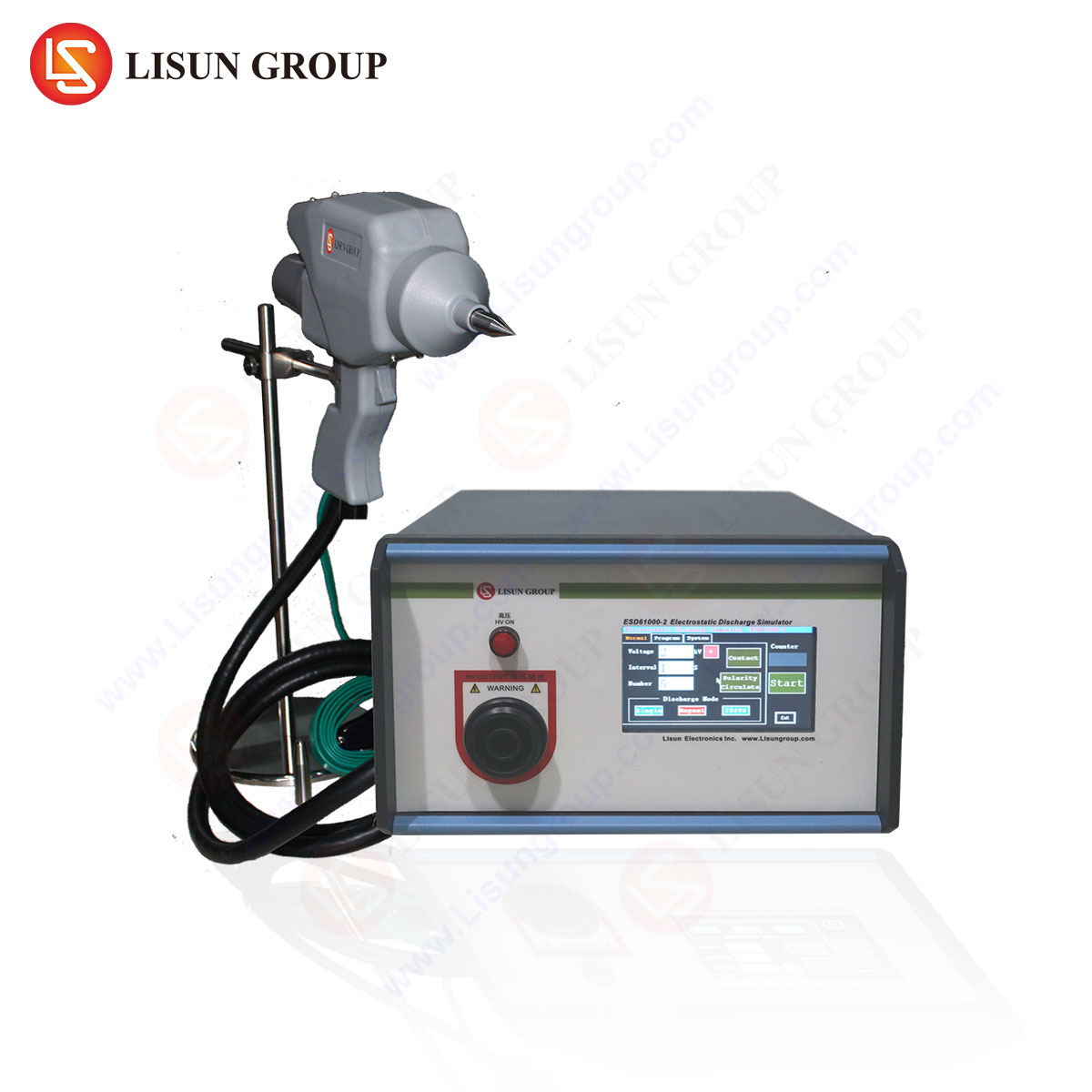


Fundamentals of Electrostatic Discharge (ESD) Testing
Electrostatic discharge (ESD) is a transient electrical phenomenon that occurs when two objects with differing electrostatic potentials come into contact or proximity, resulting in a rapid transfer of charge. ESD events can cause catastrophic failures or latent defects in electronic components, necessitating rigorous testing to ensure product reliability.
The ESD gun, a critical tool in compliance testing, simulates human-body-model (HBM) and machine-model (MM) discharge events per IEC 61000-4-2 and ANSI/ESD STM5.1 standards. These tests evaluate a device’s immunity to electrostatic discharges encountered during manufacturing, handling, or operation.
Operational Principles of ESD Guns
An ESD gun generates controlled high-voltage discharges through a relay-switched network, replicating real-world ESD events. The discharge waveform consists of a fast rise time (<1 ns) and a subsequent current decay, simulating the energy transfer from a human operator or conductive tool.
Key parameters include:
- Discharge Voltage: Adjustable from 2 kV to 30 kV, covering standard test levels.
- Discharge Modes: Contact discharge (direct coupling) and air discharge (spark-gap coupling).
- Current Waveform Compliance: Adherence to IEC 61000-4-2’s specified 4 kV/8 kV current profiles (e.g., 3.75 A/ns rise time).
ليسون ESD61000-2: Technical Specifications and Testing Capabilities
إن LISUN ESD61000-2 is a precision محاكي التفريغ الكهروستاتيكي designed for compliance testing across multiple industries. Its specifications include:
| المعلمة | Value |
|---|---|
| نطاق الجهد | 0.1–30 kV (±5%) |
| أنماط التفريغ | Contact/Air |
| القطبية | Positive/Negative |
| Current Waveform | IEC 61000-4-2 Compliant |
| Test Repetition Rate | 20 discharges/sec (max) |
| Operating Environment | 15–35°C, 30–60% RH |
إن ESD61000-2 integrates advanced discharge control, ensuring repeatable test conditions for automotive, aerospace, and medical device validation.
تطبيقات اختبار التفريغ الكهروستاتيكي في قطاعات صناعية محددة
Automotive and Rail Transit Systems
Modern vehicles incorporate sensitive electronic control units (ECUs) vulnerable to ESD. The ESD61000-2 validates immunity in infotainment systems, powertrain modules, and ADAS sensors per ISO 10605.
Medical Devices and Instrumentation
Implantable devices and diagnostic equipment must withstand ESD during surgical handling. IEC 60601-1-2 mandates testing up to 8 kV (contact) and 15 kV (air).
Industrial and Power Equipment
Variable-frequency drives (VFDs) and PLCs are tested for ESD robustness to prevent malfunctions in harsh environments.
Consumer Electronics and IT Equipment
Smartphones, routers, and audio-visual devices undergo ESD testing to mitigate failures from user interactions.
Comparative Advantages of the LISUN ESD61000-2
- Enhanced Waveform Accuracy: Proprietary circuitry ensures ±5% deviation from IEC 61000-4-2’s current waveform requirements.
- Automated Test Sequencing: Programmable discharge patterns reduce operator variability.
- الامتثال لمعايير متعددة: Supports ISO, ANSI/ESD, and MIL-STD-883H protocols.
- Robust Construction: EMI-shielded housing minimizes external interference.
Standards and Regulatory Compliance
إن ESD61000-2 aligns with:
- IEC 61000-4-2 (Immunity Testing)
- ANSI/ESD STM5.1 (HBM Evaluation)
- ISO 10605 (Automotive ESD)
- IEC 60601-1-2 (Medical Devices)
الأسئلة الشائعة (FAQ)
س1: ما الفرق بين اختبار التلامس واختبار التفريغ الهوائي؟
Contact discharge applies ESD directly via a conductive tip, while air discharge simulates sparks through an air gap.
Q2: How does the ESD61000-2 ensure waveform compliance?
Built-in calibration monitors current rise time (0.7–1 ns) and peak amplitude per IEC 61000-4-2.
Q3: Which industries require ESD testing above 15 kV?
Aerospace (MIL-STD-883H) and high-voltage power equipment often demand 20–30 kV testing.
Q4: Can the ESD61000-2 simulate charged-device model (CDM) events?
No, CDM testing requires specialized equipment like the LISUN ESD-CDM.
Q5: What maintenance is required for long-term accuracy?
Annual recalibration and relay inspection are recommended to prevent waveform degradation.
 English
 Spanish
 Russian
 Portuguese
 Turkish
 Arabic
 German
 Polish
 Italian
 French
 Korean
 Japanese
 Indonesian