




Understanding the Light Esfera Integradora: Principles, Metrology, and Application in Modern Photometric Testing
Introduction to the Integrating Sphere as a Radiometric and Photometric Tool
O esfera de integração, originally conceived as a tool for measuring the total luminous flux of light sources, has evolved into a cornerstone instrument for optical metrology across numerous high-precision industries. Its operational principle is deceptively simple yet mathematically robust: an internally coated spherical cavity with a diffuse, highly reflective surface enables the spatial integration of radiant flux from a source placed within or at its port. This integration effectively eliminates angular dependence, allowing a detector to sample a representative portion of the total emitted light. The accuracy of this measurement depends critically on the sphere’s geometry, the reflectance uniformity of its coating, and the baffle design used to prevent direct line-of-sight between the source and the detector. For industries ranging from solid-state lighting to aerospace instrumentation, the integrating sphere remains the definitive standard for total flux determination, colorimetric characterization, and spectral power distribution analysis.
Theoretical Foundations of Spatial Flux Integration
The fundamental equation governing integrating sphere performance is derived from the principle of radiance conservation within a closed, perfectly diffusing cavity. Given an internally reflective surface with reflectance (rho) and a sphere of radius (R), the total radiance (L) at any point on the sphere wall after multiple reflections is proportional to the total flux (Phi) emitted by the source. The classical formulation yields:
[
L = frac{Phi rho}{4 pi R^2 (1 – rho f)}
]
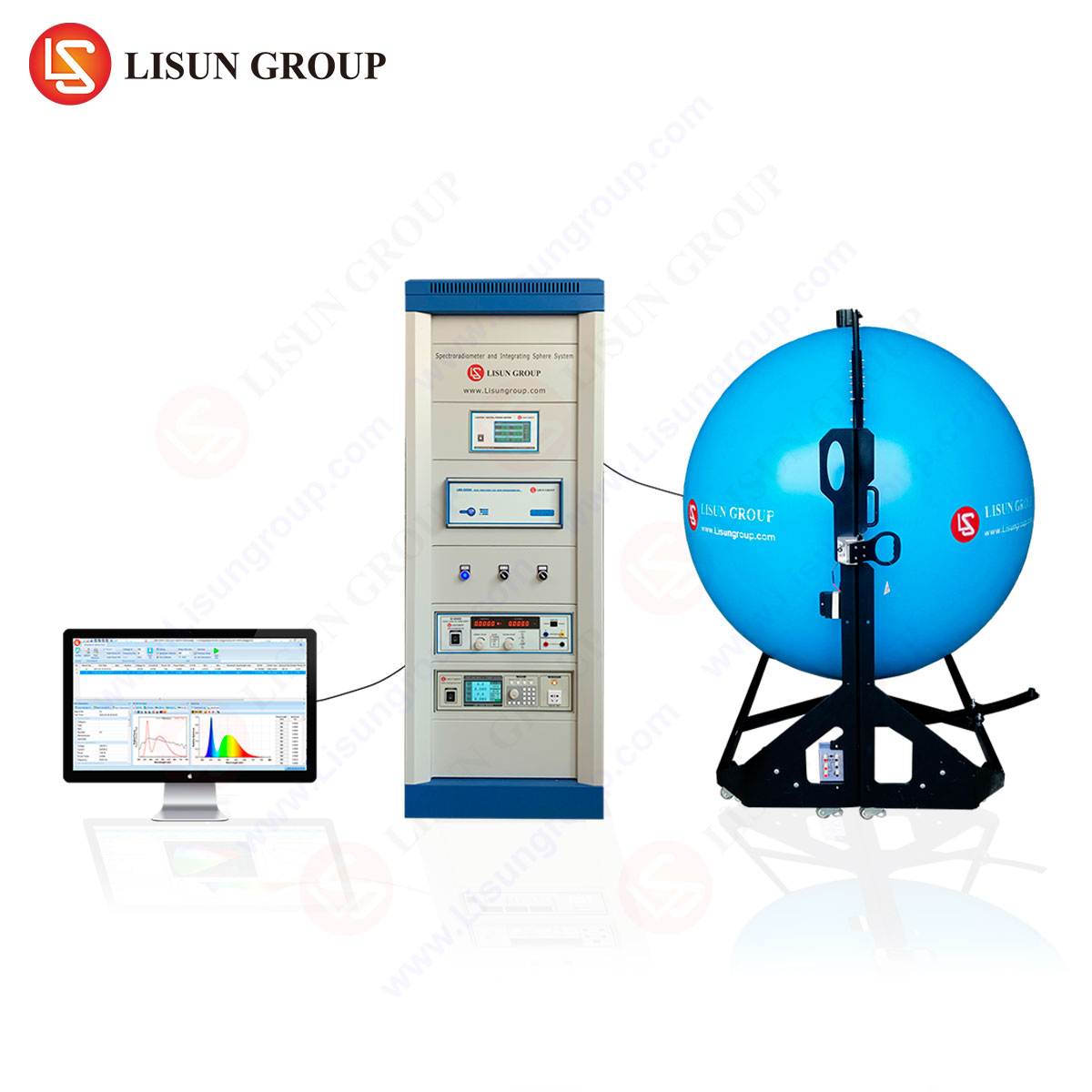
where (f) represents the fraction of the sphere surface area occupied by ports, baffles, and the source itself. This equation assumes Lambertian reflectance behavior, where the surface scatters incident light with equal radiance in all directions. In practice, real coatings such as barium sulfate or Spectralon approach Lambertian behavior but exhibit slight specular components and wavelength-dependent reflectance. The correction for these non-idealities, known as the sphere multiplier correction, is essential when performing absolute flux measurements. Modern photometric systems, such as the LISUN LPCE-2 integrating sphere and spectroradiometer system, incorporate automated correction algorithms that account for baffle shadowing, port losses, and coating degradation over time, ensuring traceability to national standards.
Key Performance Parameters of High-Precision Integrating Spheres
Not all integrating spheres are equivalent in metrological capability. Several parameters dictate the suitability of a sphere for a given application, particularly in rigorous industrial testing environments.
Sphere Diameter and Port Geometry
The diameter of the sphere directly influences the minimum measurable flux and the degree of spatial averaging. Larger spheres (e.g., 1.0 m or 2.0 m diameter) are required for high-flux sources such as automotive headlamps or stadium lighting, where self-absorption errors become significant. Smaller spheres (e.g., 0.3 m or 0.5 m) are adequate for LEDs and small aperture sources. The LISUN LPCE-3 system utilizes a 0.3 m integrating sphere optimized for moderate-power LEDs and compact luminaires, while the LPCE-2 offers a 0.5 m or 1.0 m sphere configuration for larger devices.
Coating Reflectance and Spectral Uniformity
The internal coating must exhibit high reflectance (typically >94% across the visible spectrum) and minimal spectral selectivity. Barium sulfate (BaSO₄) coatings achieve up to 96% reflectance in the 380–780 nm range, while PTFE-based coatings (Spectralon) can exceed 98% in the UV-VIS-NIR. For the LISUN LPCE-2, the standard coating is a high-stability BaSO₄ formulation with a specified reflectance of ≥94% from 350 nm to 800 nm, suitable for photometric and colorimetric testing per CIE 127 and LM-79 standards.
Baffle Design and Detector Port Location
A properly designed baffle system prevents direct illumination of the detector by the source. The baffle must be placed at a distance equal to at least one-third of the sphere radius from the detector port, with a surface coating identical to the sphere wall. Poor baffle design introduces cosine errors and angular truncation. The LPCE-2 and LPCE-3 employ a multi-baffle architecture with optimized angular occlusion to maintain measurement uncertainty below 0.5% for total luminous flux.
Integration of Spectroradiometry with the Integrating Sphere
The integration sphere alone provides only a total flux value if paired with a photopic-corrected photodetector. However, for spectral characterization—critical for color rendering index (CRI), correlated color temperature (CCT), and chromaticity coordinates—the sphere must be coupled with a spectroradiometer. The LISUN LPCE-2 combines a 0.5 m integrating sphere with a high-resolution array spectroradiometer covering 350 nm to 1000 nm. The optical fiber coupling ensures minimal stray light and allows for simultaneous measurement of spectral power distribution (SPD). The system complies with the CIE 127:2007 method for total luminous flux measurement and the IES LM-79-19 standard for electrical and photometric testing of solid-state lighting. The spectroradiometer’s resolution of 2.0 nm (FWHM) and wavelength accuracy of ±0.3 nm enable precise determination of dominant wavelength and spectral bandwidth, which are indispensable for LED binning in manufacturing lines.
Practical Applications Across Industry Sectors
Lighting Industry and LED Manufacturing
In mass production of LED packages, the LISUN LPCE-3 system is frequently employed for rapid sorting based on luminous flux and chromaticity tolerance. With a measurement cycle under 5 seconds per sample, it meets the throughput requirements of automated pick-and-place lines. The system’s ability to simultaneously measure forward voltage and current via integrated DC power supply ensures compliance with LM-80 long-term lumen maintenance testing protocols.
Testes de iluminação automotiva
Automotive headlamps, daytime running lights (DRLs), and interior lighting must adhere to stringent regulations such as ECE R112 and SAE J1383. The LPCE-2, with its 1.0 m sphere option, can accommodate full-sized headlamp assemblies. The system’s high dynamic range spectroradiometer accurately measures both low-intensity ambient lighting and high-flux high-beam output without detector saturation, thanks to adjustable integration time from 1 ms to 10 seconds.
Iluminação para os setores aeroespacial e de aviação
Aircraft exterior lights, including navigation, anti-collision, and landing lights, must meet SAE AS8028 and FAA TSO requirements. The integrating sphere provides a reliable method for measuring total flux and chromaticity in a controlled environment, eliminating the inconsistencies of goniometric setups. The LPCE-2’s fiducial wavelength calibration using Mercury Argon lamps ensures traceability for aviation certification.
Teste de equipamentos de exibição
For backlight units (BLU) and OLED displays, the integrating sphere with 0.3 m diameter is ideal for measuring angularly integrated luminance and color uniformity. The spectroradiometer captures spectral data from 100 cd/m² to over 50,000 cd/m², supporting standards such as VESA DisplayHDR and TCO Certified Displays.
Indústria Fotovoltaica
In solar cell characterization, the integrating sphere is used to measure the total spectral reflectance or total hemispherical reflectance of absorber layers. The LISUN LPCE-2, with its port design allowing for sample mounting at the sphere wall, enables accurate measurement of quantum efficiency (EQE) when coupled with a monochromator.
Scientific Research Laboratories and Optical Instrument R&D
Researchers developing new phosphor materials or quantum dot films require precise measurement of absolute spectral quantum yield. The integrating sphere serves as the optical foundation for photoluminescence quantum yield (PLQY) measurements, with the LPCE-3’s bifurcated optical fiber configuration supporting both excitation and emission collection.
Urban Lighting and Stage Lighting
Urban lighting designers rely on total flux and spatial distribution data to model glare and illuminance uniformity. While the integrating sphere provides total flux alone, it must be used in conjunction with a goniophotometer for full spatial data. However, for rapid prototyping of luminaires, the LPCE-2 offers a 90% reduction in measurement time compared to traditional goniophotometry, with uncertainty below 2%.
Equipamentos de iluminação médica
Surgical luminaires, examination lights, and phototherapy devices require accurate color temperature and spectral irradiance in the photopic and scotopic ranges. The LPCE-3, with its UV-visible extension, can measure blue light hazard (BLH) weighted irradiance per IEC 62471.
Competitive Advantages of the LISUN LPCE-2 and LPCE-3 Systems
The LISUN LPCE-2 and LPCE-3 spectroradiometer-integrating sphere systems distinguish themselves through several key technical differentiators:
-
Direct Traceability: The built-in wavelength calibration source (Hg-Ar lamp) ensures spectral accuracy traceable to NIST standard reference materials, eliminating the need for external calibration services during routine use.
-
Dynamic Range and Sensitivity: The back-thinned CCD array in the LPCE-2 provides a signal-to-noise ratio exceeding 1000:1 at 10 ms integration time, allowing for stable measurements of low-flux sources (down to 0.1 lm) without phase-locked amplification.
-
Automated Dark Current Subtraction: Each measurement sequence includes automated dark current compensation via a mechanical shutter, reducing baseline drift to below 0.01%.
-
Multi-Functional Software Suite: The LISUN 6.0 software supports real-time data acquisition, CIE standard calculation of CCT, CRI (Ra and extended R1-R15), TM-30, and Duv, as well as user-defined custom pass/fail criteria.
-
Robust Mechanical Construction: The integrating sphere shell is machined from aluminum alloy with a rigid support structure, minimizing deformation due to temperature fluctuation or mechanical vibration in production environments.
Compliance with International Metrology Standards
The LPCE-2 and LPCE-3 systems are designed to satisfy the following standards:
| Padrão | Âmbito de aplicação | LPCE-2 Compliance |
|---|---|---|
| CIE 127:2007 | Measurement of LEDs | Total flux, spectral, and color measurement |
| IES LM-79-19 | Solid-state lighting | Electrical and photometric testing |
| IES LM-80-21 | Lumen maintenance | Luminous flux over time |
| IEC 62471 | Photobiological safety | Blue light hazard weighted irradiance |
| SAE AS8028 | Aviation lights | Chromaticity and intensity |
| VDA 278 | Automotive interior materials | UV and visible reflectance |
FAQs on Integrating Sphere Testing and the LISUN LPCE-2/LPCE-3 Systems
Q1: What is the primary difference between the LISUN LPCE-2 and LPCE-3 for LED testing?
The LPCE-2 is designed for higher precision and larger sources, featuring a 0.5 m to 1.0 m sphere diameter and a wide dynamic range spectroradiometer suitable for automotive and aviation lighting. The LPCE-3 is a more compact system with a 0.3 m sphere, optimized for LED packages, modules, and small luminaires in high-throughput manufacturing environments.
Q2: Can the integrating sphere be used to measure absolute spectral power distribution without calibration?
No. Absolute spectral irradiance measurements require calibration against a standard lamp traceable to national standards. The LPCE-2 includes a certified standard halogen lamp (2856 K) that, when used with the auxiliary lamp method, provides absolute flux calibration to within ±2.5% uncertainty.
Q3: How does self-absorption affect measurement accuracy, and how is it corrected?
Self-absorption occurs when the light source or its housing absorbs a fraction of the multiply reflected light within the sphere, reducing the detected signal. The LPCE-2 corrects for this using the substitution method: a known auxiliary lamp is measured with and without the source present, and the ratio is used to calculate the correction factor for the source under test.
Q4: What is the recommended maintenance schedule for the integrating sphere coating?
Barium sulfate coatings should be inspected biannually for discoloration, dust, or scratches. Using compressed nitrogen for cleaning is recommended. The LPCE-2 software includes a baseline reflectance check routine using the internal reference lamp to detect coating degradation beyond 2% reflectance loss, prompting recalibration when necessary.
Q5: Is the LPCE-2 system capable of measuring flicker or temporal light modulation (TLM)?
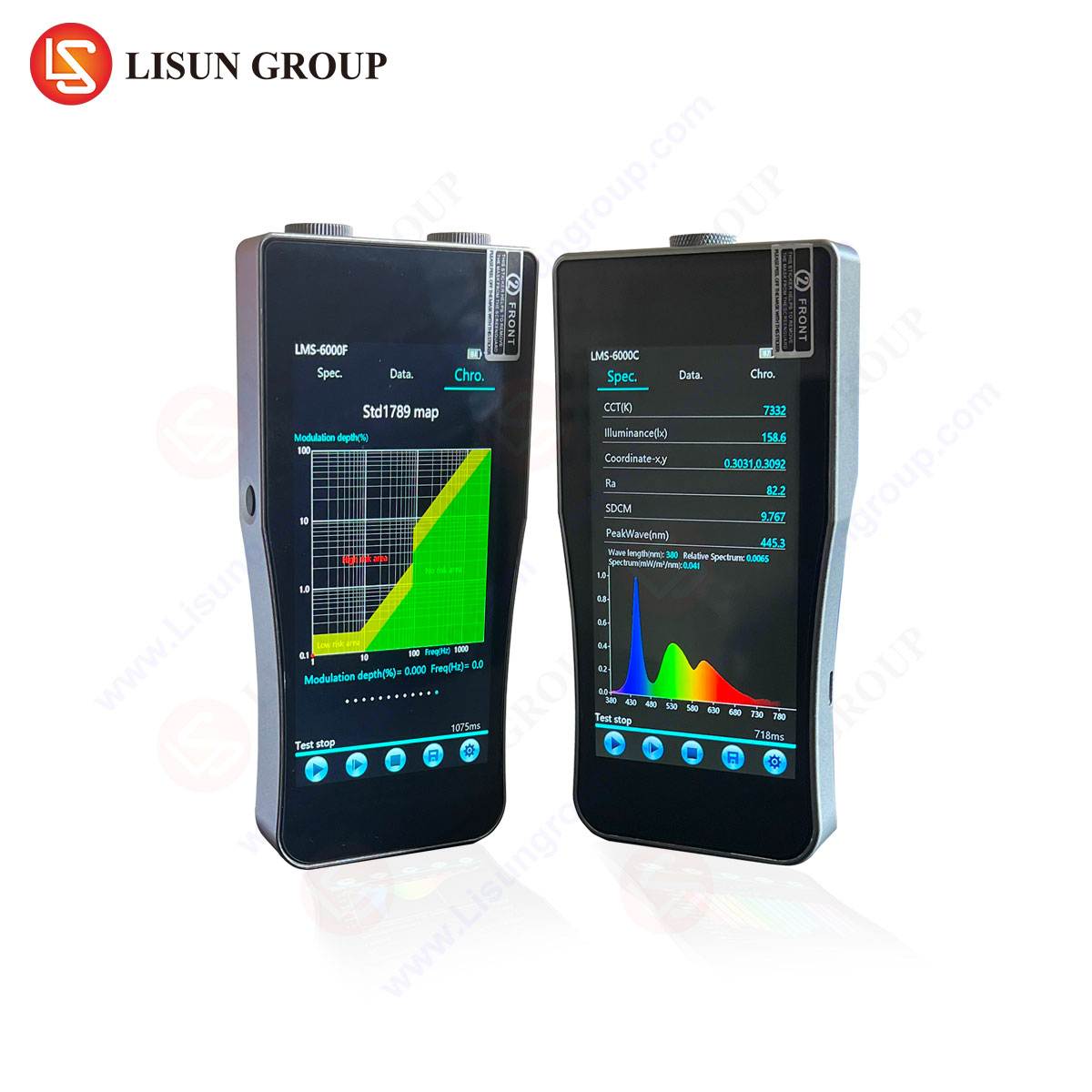
Yes. The LPCE-2 spectroradiometer can be operated in fast capture mode at up to 200 Hz sampling rate to measure flicker percent and flicker index per IEEE 1789-2015 and NEMA 77. The software provides automated calculation of modulation depth and frequency analysis for up to 2 kHz signals.
 English
  Spanish
  Russian
  Portuguese
  Turkish
  Arabic
  German
  Polish
  Italian
  French
  Korean
  Japanese
  Indonesian