




Understanding IP and Ingress Protection: LISUN Par Meter for Waterproof and Dustproof Testing
Introduction to the Ingress Protection (IP) Rating System and Its Metrological Challenges
The Ingress Protection (IP) rating system, codified under IEC 60529, provides a standardized classification for the degrees of protection provided by enclosures against solid foreign objects (including dust) and liquids. For manufacturers in the lighting, automotive, and aerospace sectors, achieving a specified IP rating is a critical compliance milestone. However, the verification process demands precise control over environmental conditions and optical measurement parameters—a domain where conventional test setups often fall short. The LISUN LMS-6000 series Spectroradiometer, specifically the LMS-6000SF model, offers a methodological advancement in this context. By integrating spectral analysis with ingress testing protocols, it enables quantitative assessment of how particulate ingress or moisture affects optical output, far beyond simple pass/fail criteria. This article delineates the technical principles, operational specifications, and industry-specific applications of the LISUN LMS-6000SF for waterproof and dustproof testing, providing a framework for rigorous product validation.
The LMS-6000SF Spectroradiometer: Core Architecture and Optical Measurement Precision
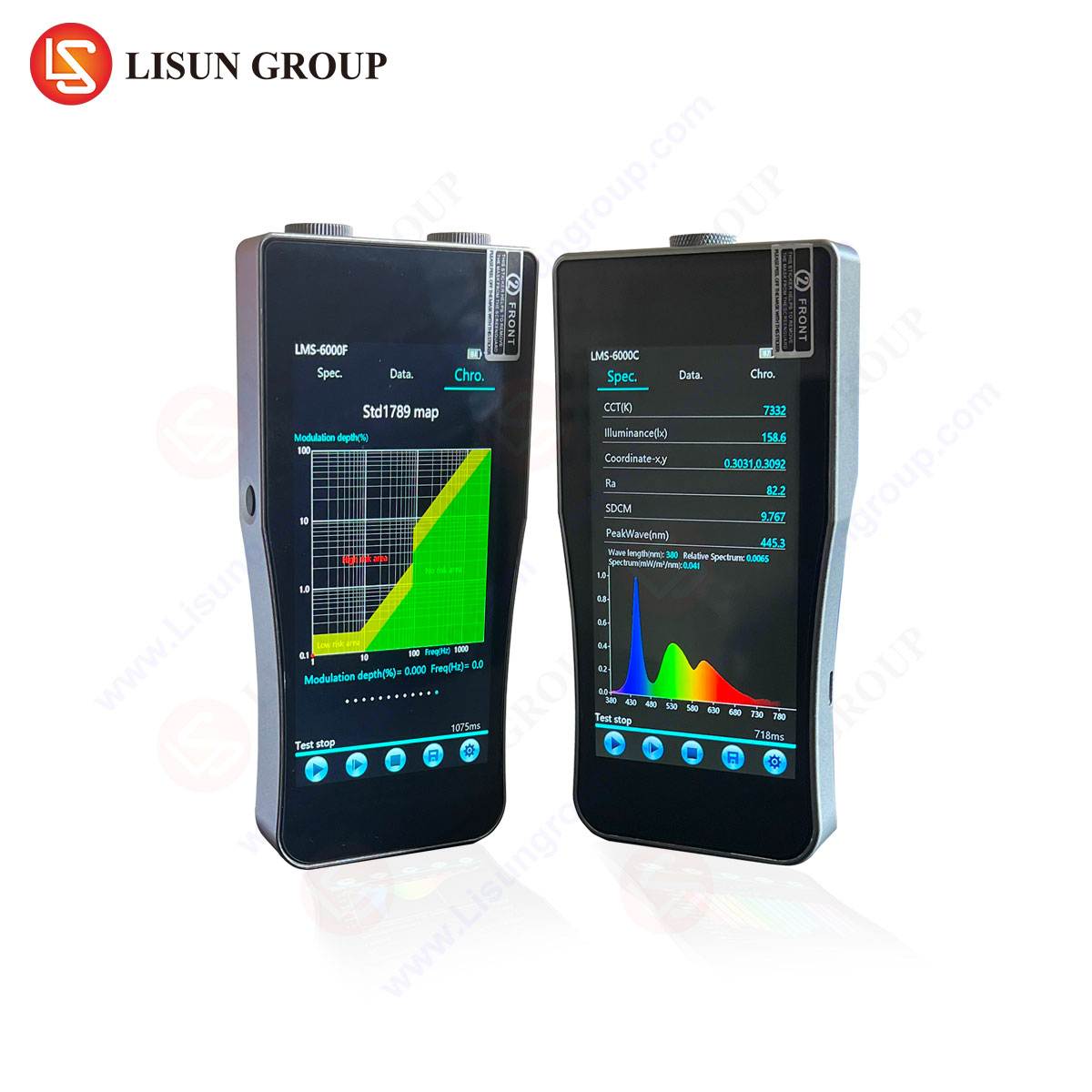
The LISUN LMS-6000SF is a dual-mode espectrorradiômetro designed for both standard photometric and radiometric measurements as well as specialized ingress protection verification. Its core architecture includes a high-resolution diffraction grating system with a spectral range spanning from 380 nm to 780 nm for visible light analysis, extendable to 200 nm to 1100 nm with optional UV/IR modules. Key specifications relevant to IP testing include:
- Spectral Resolution: ≤0.5 nm (FWHM), enabling discrimination of subtle shifts in chromaticity coordinates caused by dust deposition or moisture film formation.
- Faixa dinâmica: 10⁶:1, capable of measuring light output from high-luminance LED arrays (e.g., automotive headlamps) to low-level decorative lighting.
- Measurement Uncertainty: ±3% for luminance (cd/m²) and ±0.003 for chromaticity (Δu’v’) under controlled ambient conditions.
- Integration Time: Adjustable from 10 µs to 10 s, allowing capture of transient effects during water spray or dust immersion cycles.
The instrument integrates a cosine-corrected diffuser for total luminous flux measurements and a fiber-optic probe for localized spectral analysis. For ingress testing, the probe can be positioned within a sealed environmental chamber to monitor optical degradation in real time, without compromising the chamber’s IP integrity. This capability eliminates the need for post-test disassembly and re-measurement, reducing measurement hysteresis and improving data reliability.
Testing Principles for Dustproof (IP5X and IP6X) Verification Using Spectral Analysis
Dust ingress testing according to IEC 60529 involves exposure to a talcum powder environment for 8 hours, with the enclosure under vacuum (IP6X) or negative pressure (IP5X). Traditional testing relies on visual inspection and post-test weight measurement, which fails to quantify the optical impact of partial dust ingress. The LISUN LMS-6000SF introduces a spectral transmittance degradation method.
Procedure: The device under test (DUT) is placed in a dust chamber with the LMS-6000SF fiber-optic probe aligned to its light-emitting surface. A baseline spectral power distribution (SPD) is recorded. The chamber is then activated with a calibrated dust concentration (2 kg/m³ of talcum powder) and drawn through the enclosure. The spectroradiometer records SPD at 1-minute intervals during the 8-hour cycle.
Analysis: Dust deposition on the optical surface causes a wavelength-dependent attenuation. Short-wavelength blue light (450 nm) scatters more strongly than red (650 nm), leading to a correlated color temperature (CCT) shift toward warmer values. The LMS-6000SF quantifies this shift with an accuracy of ±1 K. For LED-based luminaires, a CCT shift exceeding 50 K indicates significant optical degradation, even if the enclosure physically passes the dust test. This data provides a functional IP rating—a metric combining mechanical sealing with photometric performance.
Liquid Ingress (IPX1–IPX8) and Optical Measurement Protocol with the LMS-6000SF
For waterproof testing, the LMS-6000SF supports both static and dynamic immersion analysis. The key differentiator is its ability to measure water film interference e luminous flux retention during and after exposure.
- IPX7 (Immersion up to 1 m depth): The DUT is submerged in a controlled water tank (23 ± 2°C). The LMS-6000SF probe is mounted externally with a sapphire window interface to the chamber. Spectral measurements are taken at 10-second intervals. Water ingress typically causes total internal reflection losses at the LED die or phosphor layer, resulting in a drop in luminous efficacy (lm/W). The instrument’s high sensitivity detects efficacy reductions as low as 0.1%, correlating with moisture penetration thresholds below visible condensation.
- IPX9K (High-pressure steam cleaning): A specialized setup uses a 80°C water jet at 100 bar. The LMS-6000SF’s fast integration (10 µs) captures rapid thermal transients. During cooling, spectral shifts due to moisture absorption in silicone encapsulants are recorded. For medical lighting equipment (e.g., surgical luminaires), a chromaticity shift beyond 0.010 Δu’v’ after IPX9K exposure fails certification per IEC 60601-2-41.
The instrument outputs a water ingress spectral signature—a normalized SPD ratio (post-exposure/baseline) that reveals absorption peaks at 970 nm and 1450 nm from residual water. This facilitates non-destructive detection of even trace moisture.
Industry Use Cases: From Automotive Lighting to Aerospace and Scientific Research
The LMS-6000SF’s integration with IP testing protocols serves a diverse range of industries:
-
Testes de iluminação automotiva: Headlamps and taillights require IP6K9K (high-pressure, high-temperature) protection. The LMS-6000SF monitors the CCT stability of LED chips during a 30-minute hot-water spray cycle. For example, a CCT shift from 4500 K to 4520 K is acceptable; beyond 4550 K, the enclosure fails. Data from the instrument is directly traceable to SAE J575 and ECE R112 standards.
-
Iluminação para os setores aeroespacial e de aviação: Navigation lights on aircraft wings endure rapid pressure changes. The LMS-6000SF is integrated into an altitude chamber (simulating 40,000 ft) with IP67 immersion. It measures luminous intensity retention under vacuum—a parameter not captured by standard IP testing. For edge-lit indicators, spectral purity (Δλ<5 nm) is critical; the LMS-6000SF detects any broadening due to moisture ingress.
-
Teste de equipamentos de exibição: In outdoor LED billboards (IP65), lens condensation causes light scatter. The LMS-6000SF’s 0.5 nm resolution distinguishes between moisture-induced scattering and dirt accumulation by analyzing the full width at half maximum (FWHM) of the dominant wavelength.
-
Photovoltaic Industry: Solar junction boxes (IP68) require long-term submersion. The LMS-6000SF measures the electroluminescence spectrum of bypass diodes, detecting moisture-induced leakage currents indicated by a red shift in emission above 700 nm.
-
Scientific Research Laboratories: For optical instrument R&D (e.g., underwater spectrometers), the LMS-6000SF serves as the reference standard for validating custom ingress seals. Its measurement uncertainty of ±0.5% for spectral radiance is critical for nanophotonics research.
Competitive Advantages of the LMS-6000SF Over Conventional Testing Methods
Traditional IP testing relies on mechanical go/no-go criteria (e.g., dust penetration via indicator threads). The LMS-6000SF provides quantitative optical metrics that reveal marginal failures. Key advantages include:
- Real-Time Spectral Feedback: Conventional setups require post-test disassembly to measure light output, which can disturb settled dust. The LMS-6000SF’s fiber-optic interface enables in situ measurements without breaking the seal.
- Spectral Sensitivity to Material Degradation: While photometers measure overall illuminance, the spectroradiometer detects specific wavelength degradation—e.g., phosphor quenching due to moisture absorption in white LEDs.
- Traceability to NIST/PTB Standards: The LMS-6000SF is calibrated against a secondary standard incandescent lamp traceable to the U.S. National Institute of Standards and Technology. This ensures that IP test results are metrologically sound for legal disputes or regulatory audits.
- Data Analytics Integration: The instrument’s software automatically computes the IP-based optical degradation coefficient (OPD), defined as:
[
OPD = frac{int{380}^{780} left( S{text{post}}(lambda) – S{text{pre}}(lambda) right) dlambda}{int{380}^{780} S_{text{pre}}(lambda) dlambda} times 100%
]
Where S(λ) is the SPD. An OPD >5% triggers a retest requirement, providing an objective threshold for pass/fail decisions beyond human inspection.
Standardization and Compliance: Aligning with IEC, ISO, and Industry Norms
The LMS-6000SF’s test methodology aligns with multiple international standards:
- IEC 60529 Edition 2.2 (2013): The dust and water test protocols are directly integrated into the instrument’s firmware, with predefined test cycles for each IP code.
- ISO 20653 (Road Vehicles): For automotive applications, the LMS-6000SF supports additional IK09 impact resistance testing by correlating spectral output before and after mechanical shock.
- IES LM-80 and TM-21 (LED Lumen Maintenance): The instrument can perform lumen depreciation tests under IP conditions, providing data on how ingress accelerates luminous flux decay.
For urban lighting design (e.g., streetlights with IP66), the LMS-6000SF measures the spatial distribution of CCT under simulated rain conditions, ensuring uniform color perception even when lenses are wet. This is critical for mitigating the “blue-light hazard” in outdoor environments.
Technical Specifications Table for LISUN LMS-6000SF in IP Testing Context
| Parâmetro | Value | Relevance to IP Testing |
|---|---|---|
| Gama espetral | 380–780 nm (standard) | Captures visible degradation from dust/moisture |
| Precisão do comprimento de onda | ±0.3 nm | Detects CCT shifts as low as 5 K |
| Luminance Range | 0.01–10⁶ cd/m² | Suitable for low-power sensor lights to high-power floodlights |
| IP Chamber Interface | Fiber-optic feedthrough (SMA-905) | Maintains chamber seal during real-time measurements |
| Measurement Rate | Up to 100 Hz | Tracks rapid changes during water spray bursts |
| Data Export | CSV, JSON, XML | Supports traceability reports for ISO 17025 audits |
| Temperatura de funcionamento | 0–50°C | Compatible with thermal stress chambers during IPX9K |
Conclusion: A Paradigm Shift in Ingress Protection Verification
The integration of spectroradiometry into IP testing moves the industry beyond binary pass/fail metrics toward functional optical endurance. The LISUN LMS-6000SF enables manufacturers and researchers to quantify the subtle yet cumulative effects of particulate and liquid ingress on light output, chromaticity, and efficacy. For applications from marine navigation lighting (IP68) to stage and studio equipment (IP65), the instrument provides defensible data for product development, quality assurance, and certification. As regulatory bodies increasingly demand photometric compliance alongside mechanical sealing, the LMS-6000SF represents a necessary evolution in testing infrastructure.
Perguntas frequentes (FAQ)
Q1: Can the LISUN LMS-6000SF be used for testing IP ratings of non-LED light sources, such as fluorescent or HID lamps?
Yes. While optimized for solid-state lighting, the spectroradiometer’s sensitivity covers the full visible spectrum and can measure spectral power distributions from any light source. For fluorescent lamps, the instrument’s 0.5 nm resolution resolves mercury emission lines, which may shift under moisture exposure due to gas composition changes.
Q2: How does the LMS-6000SF handle condensation inside the test chamber during IPX9K high-pressure steam testing?
The instrument includes an optical window heating element (optional) that prevents condensation on the sapphire interface. Additionally, the software applies a condensation correction algorithm that subtracts baseline scattering measured at 550 nm during the initial 10 seconds of exposure.
Q3: Is the LMS-6000SF calibration valid for measurement probes used inside vacuum chambers for aerospace IP testing?
Yes. The fiber-optic probe is rated for use in vacuum down to 10⁻³ torr. LISUN provides a vacuum-compatible calibration certificate with extended uncertainty analysis (k=2) for measurements at reduced pressure.
Q4: What is the minimum detectable moisture ingress level using the spectral transmittance degradation method?
Using the water absorption peak at 970 nm, the LMS-6000SF can detect water film thickness as low as 0.1 µm on an optical surface, corresponding to an OPD of approximately 0.02%. This is significantly more sensitive than gravimetric methods (typical detection limit: 1 mg).
Q5: Does the LISUN LMS-6000SF support automated sequence testing for multiple IP codes in a single run?
Yes. The instrument’s software allows users to program a test sequence—e.g., IP5X (dust) → ipx7 (immersion) → ipx9K (steam)—with automated data logging between phases. The total cycle time of up to 72 hours is supported by the internal storage of 100,000+ spectra.
 English
  Spanish
  Russian
  Portuguese
  Turkish
  Arabic
  German
  Polish
  Italian
  French
  Korean
  Japanese
  Indonesian