




عنوان: The Essential Role of CCT CRI Lux Meter in Professional Lighting Quality Assessment: Integrating Spectroradiometric Precision with the ليسون LMS-6000 Series
خلاصة
The quantification of lighting quality extends far beyond simple illuminance measurement. In modern photometric and colorimetric science, the correlated color temperature (CCT), color rendering index (CRI), and illuminance (Lux) constitute a triad of critical parameters that define the perceptual and functional efficacy of a light source. This article delineates the indispensable role of the CCT CRI Lux meter as a unified diagnostic instrument, with a specific focus on the LISUN LMS-6000 مطياف إشعاعي series. By examining its operational principles, technical specifications, and cross-industry applications—from LED manufacturing to aerospace lighting—this paper establishes the necessity of integrated spectroradiometric analysis for rigorous lighting quality assurance.
H2: The Triadic Diagnostic: CCT, CRI, and Lux as Interdependent Metrics in Lighting Metrology
In the domain of lighting quality assessment, no single parameter can provide a holistic evaluation. Correlated Color Temperature (CCT) describes the chromaticity of a light source relative to a blackbody radiator, influencing human circadian rhythms and visual comfort. The Color Rendering Index (CRI), as defined by the International Commission on Illumination (CIE), quantifies the fidelity of color appearance under a test source compared to a reference illuminant. Illuminance (Lux), the photometric measure of luminous flux per unit area, dictates functional visibility.
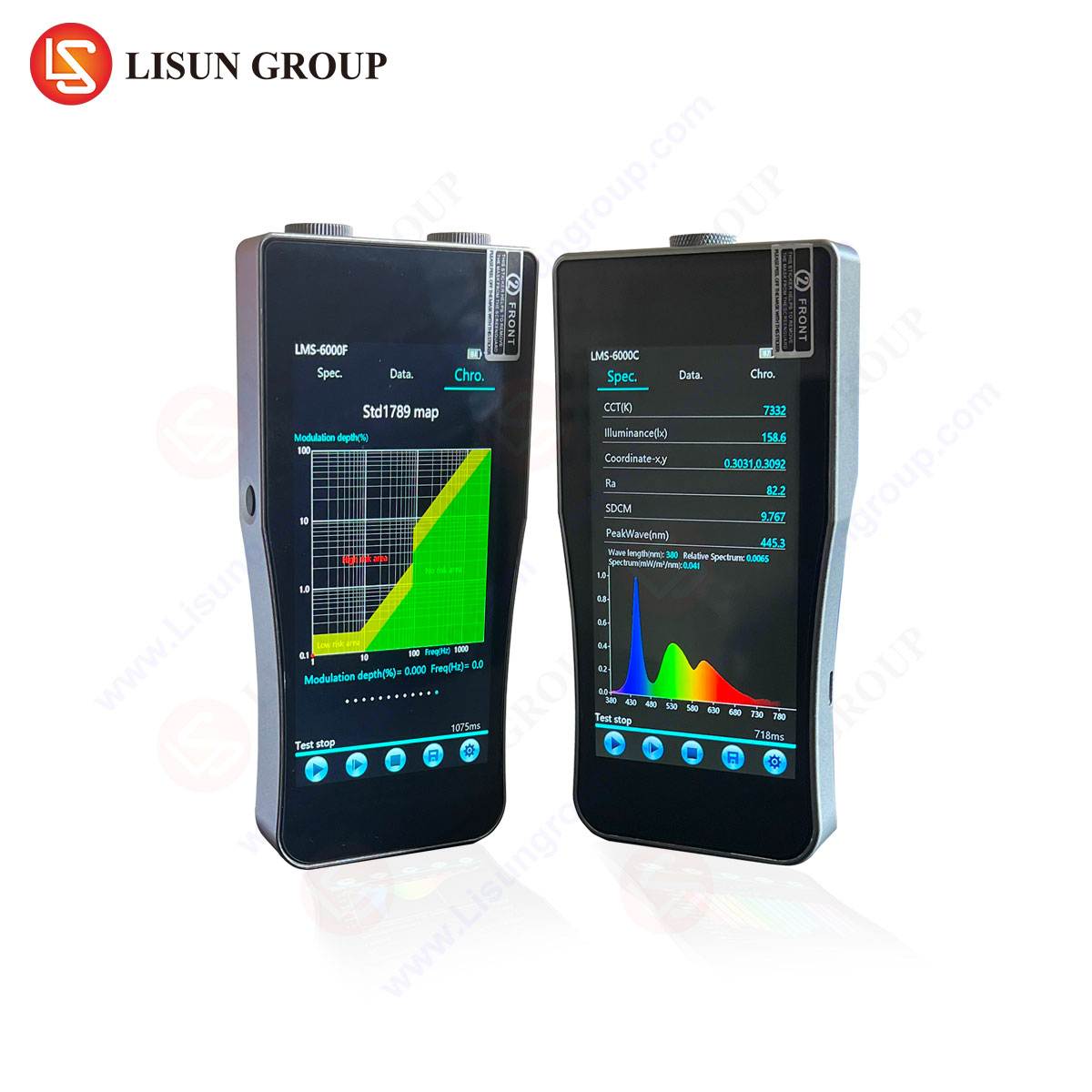
However, these metrics are interdependent. A high CRI value is meaningless if the CCT does not match the application environment, and a precise Lux reading is insufficient if the spectral power distribution (SPD) introduces color distortion. A dedicated CCT CRI Lux meter, therefore, must not merely measure these values individually but must derive them from a single, high-resolution spectral scan. The LISUN LMS-6000 accomplishes this by employing an array-based spectroradiometer that captures the full SPD from 380nm to 780nm, enabling simultaneous computation of CCT (with ±5K accuracy for standard illuminants), CRI (Ra and extended R-values), and Lux (Class A photometric grade).
H2: Spectroradiometric Architecture of the LISUN LMS-6000 Series: From SPD to Secondary Metrics
The fundamental distinction between a conventional lux meter and a CCT CRI Lux meter lies in the measurement principle. Conventional devices rely on filtered photodiodes that approximate the photopic luminosity function V(λ), leading to inherent errors when measuring narrowband sources such as LEDs. The LISUN LMS-6000 spectroradiometer, conversely, operates via diffraction grating dispersion and a high-sensitivity CCD array.
Measurement Workflow:
- Spectral Acquisition: Incoming light is collected via a cosine-corrected diffuser and transmitted through an optical fiber to the spectrometer.
- Dispersion and Detection: The grating separates the light into its constituent wavelengths. The CCD array captures the intensity across 2048 pixels, providing a spectral resolution of approximately 0.2nm.
- Photometric Conversion: The raw spectral data (W/nm) is multiplied by the CIE 1931 standard observer color-matching functions (x̄(λ), ȳ(λ), z̄(λ)) to derive tristimulus values (X, Y, Z).
- Parameter Derivation:
- Lux: Calculated from the Y tristimulus value (683 * Y lumens/m²).
- CCT: Computed using the McCamy or Robertson method from the (u’, v’) chromaticity coordinates.
- CRI: Calculated by comparing the chromaticity shift of eight standard Munsell test color samples (R1–R8) under the test source versus a reference source of matching CCT.
This architecture ensures that the LMS-6000 delivers spectral accuracy that far exceeds filter-based meters, particularly for sources with discontinuous spectra.
H2: Technical Specifications and Metrological Tolerances of the LISUN LMS-6000F and LMS-6000S
For professionals in lighting quality assessment, understanding instrument tolerance is non-negotiable. The LISUN LMS-6000 series offers model-specific advantages tailored to distinct industrial requirements.
| المعلمة | LISUN LMS-6000F (Standard) | LISUN LMS-6000S (High Precision) |
|---|---|---|
| Spectral Range | 380nm – 780nm | 350nm – 1050nm (extended to NIR) |
| دقة الطول الموجي | ±0.5nm | ±0.3 نانومتر |
| Illuminance Accuracy | ±3% (Class A) | ±2% (Class AA) |
| CCT Measurement Range | 1,500K – 100,000K | 1,000K – 100,000K |
| CRI Measurement | Ra, R1–R15 | Ra, R1–R15, Rf (IES TM-30), Rg |
| Integration Time | 1ms – 10s | 0.1ms – 20s |
The LMS-6000S model’s extended spectral range is critical for applications involving UV-cured adhesives in medical lighting or near-infrared emissions in photovoltaic characterization. The high dynamic range allows accurate measurement from low luminance (marine navigation lighting) to high intensity (stage lighting arcs) without saturation.
H2: Application in LED and OLED Manufacturing: Spectral Tolerance and Bin Classification
In the manufacturing of LEDs and OLEDs, the primary metric for quality control is the chromaticity bin. A deviation of ±50K in CCT can render an entire batch unacceptable for architectural or commercial lighting contracts. The LISUN LMS-6000F facilitates inline testing by providing real-time CCT and Duv (distance from the Planckian locus) values.
Case Example: A 3000K LED module intended for hospitality lighting must exhibit a Duv of less than 0.003. Using the LMS-6000, manufacturers can:
- Identify spectral shifts caused by phosphor degradation.
- Sort LEDs into MacAdam ellipse bins (e.g., 3-step, 5-step).
- Validate CRI Ra > 90 for premium OLED panels.
Furthermore, the instrument supports IES LM-79-19 testing protocols, enabling certification laboratories to output absolute photometry data files (.ies) directly from spectral scans.
H2: Automotive Lighting Testing: Compliance with SAE and ECE Standards for Headlamp Quality
Automotive lighting systems, including adaptive front-lighting systems (AFS) and matrix LEDs, require stringent chromaticity and color rendering verification. The SAE J578 and ECE R112 standards mandate that headlamp color must lie within a specific white region on the CIE 1931 chromaticity diagram.
The LISUN LMS-6000P, a portable variant with high-speed trigger capability, is used for:
- Flicker Analysis: Integration times as short as 0.1ms capture transient chromaticity shifts in PWM-driven LEDs.
- Uniformity Scanning: Mapping CCT variation across a headlamp’s light distribution pattern.
- Signal Light Verification: Ensuring red turn signals and white low beams maintain chromaticity coordinates within regulatory boundaries.
Competitive advantage arises from the device’s ability to log over 100,000 data points per session without spectral aliasing, a critical feature for high-volume validation in Tier 1 automotive suppliers.
H2: Aerospace and Aviation Lighting: Ensuring Perceptual Constancy Under Variable Load Conditions
Aviation lighting, whether for cockpit instrumentation, runway approach systems, or cabin ambient lighting, demands spectral stability under extreme temperature fluctuations and electrical variance. The human eye is exceptionally sensitive to color shifts in low-light environments, where a deviation of 2% in CCT can cause visual task errors.
In this sector, the LISUN LMS-6000UV variant (with UV capability up to 280nm) is deployed to test:
- Instrument Backlighting: Ensuring uniform CCT across all displays to reduce pilot fatigue.
- Exterior Position Lights: Compliance with FAA AC 20-30B for chromaticity limits.
- Emergency Evacuation Path Marking: Photoluminescent materials require exact Lux and spectral excitation data.
The device’s integrated temperature sensor compensates for thermal drift in the CCD, maintaining 0.5% repeatability over a 0°C to 50°C operating range.
H2: Display Equipment Testing and Photovoltaic Characterization: Beyond Visible Spectrum
The convergence of display manufacturing and photovoltaic testing relies on spectroradiometric rather than photopic measurements. For OLED and MicroLED displays, the LMS-6000SF (Stray Light Filtered) model provides:
- Gamma Curve Verification: Across different gray levels, ensuring no chromaticity shift at low luminance.
- HDR Brightness Measurement: Capable of measuring up to 10,000,000 cd/m² with appropriate attenuators.
In the photovoltaic industry, spectral mismatch correction is essential for PV module calibration. The LMS-6000’s ability to output absolute SPD (W/m²/nm) under AM1.5G standard conditions allows researchers to:
- Calculate the spectral mismatch factor (MMF) for reference cell calibration.
- Validate the performance of perovskite solar cells under varying spectral distributions.
H2: Urban Lighting Design and Stage/Studio Lighting: Balancing Efficacy and Aesthetic
Urban lighting designers require CCT and CRI data to balance energy efficiency with visual comfort. The LMS-6000 is used for:
- Mesopic Vision Assessment: Evaluating street lighting at low Lux levels to ensure pedestrian safety.
- Tunnel Lighting: Ensuring smooth CCT transition from 4000K (daytime) to 2500K (nighttime) without abrupt color breaks.
In stage and studio environments, the R12 (blue) and R13 (skin tone) CRI values are critical. The LMS-6000S provides extended CRI (R1–R15) plus IES TM-30 fidelity index (Rf) and gamut index (Rg). This enables lighting directors to:
- Match fluorescent, tungsten, and LED fixtures to cinematic color standards (Rec. 709, DCI-P3).
- Calibrate moving heads and wash lights for consistent color temperature across a rig featuring multiple emitter types.
H2: Medical Lighting Equipment Validation: ISO 13485 Compliance and Chromaticity Standards
Medical lighting, particularly for surgical suites, must adhere to ISO 13485 and IEC 60601 standards. The color temperature of an operating room lamp (typically 4000K–5000K) must render tissue colors without spectral distortion to avoid misdiagnosis. The LMS-6000UV is used to:
- Verify that the CRI Ra > 95 for all surgical lights.
- Measure UV content (280nm–400nm) to ensure minimal erythemal radiation for prolonged exposure.
- Assess Lux uniformity across the surgical field (±10% tolerance).
The unit’s data export to CSV and direct integration with LabVIEW allows biomedical engineers to automate compliance auditing.
H2: Competitive Advantages of LISUN Spectroradiometer over Conventional Filter-Based Solutions
The primary competitive differentiator of the LISUN LMS-6000 series is its dual-path optical design that minimizes stray light interference, a common artifact in compact spectrometers. This design achieves a signal-to-noise ratio (SNR) greater than 3000:1, enabling accurate measurement of low-level ambient lighting (down to 0.1 Lux) and high-intensity arc lamps concurrently.
| ميزة | Conventional Filter Lux Meter | LISUN LMS-6000 (Spectroradiometer) |
|---|---|---|
| Spectral Resolution | 20–50nm (broadband) | 0.2nm |
| CCT Accuracy | ±100K | ±5K (standard source) |
| CRI Repeatability | ±2% (Ra) | ±0.3% (Ra) |
| Measurement Speed | 50ms | 1ms (fast scan mode) |
| Data Depth | CCT, Lux | Full SPD, CCT, CRI, Duv, Rf, Rg |
Furthermore, the LMS-6000 series features a user-swappable slit (25µm to 200µm), allowing the user to optimize between spectral resolution and light throughput for different applications.
H2: Future-Proofing Optical Instrument R&D with Programmable Spectral Analysis
For optical instrument R&D laboratories, the LMS-6000 serves as a reference tool for calibrating secondary standards. Its API support (USB, RS-232, and Ethernet) enables integration into automated test benches. The software suite includes macro scripting for:
- Batch spectral averaging (to reduce noise in low-signal scenarios).
- Automated pass/fail thresholding لخطوط الإنتاج.
- إخراج إحداثيات لونية مخصصة (CIELAB، CIELUV، CIE RGB).
مع تطور تكنولوجيا الإضاءة نحو مصادر بيضاء قابلة للضبط ومصادر متعددة الأطياف، تصبح قدرة جهاز قياس الطيف الإشعاعي على تخزين منحنيات SPD المرجعية للمقارنة مع القياسات الحية لا تقدر بثمن.
H2: الإضاءة البحرية والملاحية: اللونية في البيئات البحرية والساحلية
يجب أن تلتزم أضواء الملاحة على السفن بلوائح منع التصادم في البحار (COLREGS)، التي تحدد إحداثيات اللون الدقيقة للأضواء الحمراء والخضراء والبيضاء. يتيح المشتت المقاوم للماء والغلاف المتين لجهاز LMS-6000S إجراء الاختبارات الميدانية في الأحواض الجافة. يوفر الجهاز ما يلي:
- تحليل تدهور مصابيح LED للعوامات البحرية التي تعمل بالطاقة الشمسية.
- التحقق من إشارات المرور الزرقاء والصفراء تُستخدم في المنصات البحرية.
الفرضية الثانية: الخلاصة: الدقة التآزرية في تقييم جودة الإضاءة الاحترافية
يتجاوز مقياس الإضاءة LISUN LMS-6000 CCT CRI Lux قيود أجهزة القياس الضوئي التقليدية، إذ يوفر بصمة طيفية شاملة لأي مصدر ضوئي. بدءًا من ضمان دقة تصنيف الألوان في خطوط إنتاج مصابيح LED، وصولًا إلى التحقق من معايير الإضاءة الجراحية، يوفر تصميمه الطيفي الإشعاعي المتكامل إمكانية التتبع والتكرار وعمق التحليل اللازم لتقييم الجودة بدقة. ومع توجه الصناعات نحو الإضاءة التي تركز على راحة المستخدم وإعادة إنتاج الألوان بدقة عالية، تُعد سلسلة LMS-6000 أداة أساسية للبحث العلمي والامتثال التنظيمي وهندسة المنتجات.
الأسئلة الشائعة: جهاز قياس الطيف الإشعاعي LISUN LMS-6000
1. ما هو الفرق بين LMS-6000F و LMS-6000S من حيث قياس CRI؟
يقيس جهاز LMS-6000F مؤشر تجسيد اللون Ra ونطاق R1-R15 الممتد، وهو مناسب للإضاءة العامة. أما جهاز LMS-6000S فيضيف مقاييس IES TM-30 (Rf وRg)، مما يوفر تحليلاً أكثر شمولاً لدقة اللون ونطاقه، وهو أمر بالغ الأهمية لشاشات العرض المتطورة وإضاءة الاستوديوهات.
2. هل يمكن استخدام جهاز LMS-6000 لقياس الوميض في مشغلات LED؟
نعم. يدعم الجهاز أوقات التكامل المنخفضة التي تصل إلى 0.1 مللي ثانية (LMS-6000S) ويمكنه تسجيل البيانات الزمنية بمعدلات أخذ عينات عالية لاكتشاف مؤشرات الوميض ونسبة التعديل وفقًا لمعايير IEEE 1789.
3. هل يتطلب الجهاز إعادة معايرة دورية؟
نعم. توصي شركة LISUN بإعادة المعايرة السنوية باستخدام مصباح معياري معتمد من المعهد الوطني للمعايير والتكنولوجيا (NIST). يتضمن الجهاز مصدر معايرة مدمجًا للطول الموجي (خط الزئبق-الأرجون أو النيون) للتحقق الذي يبدأه المستخدم.
4. ما هي أقصى قيمة لوكس يمكن لجهاز LMS-6000 قياسها دون حدوث توهين؟
يستطيع الإصدار القياسي قياس ما يصل إلى 200,000 لوكس. أما بالنسبة للشدات الأعلى (مثل أجهزة محاكاة الطاقة الشمسية أو إضاءة الملاعب)، فإن مُخفِّف الكثافة المحايدة (متوفر بشكل منفصل) يوسع النطاق إلى 10,000,000 لوكس.
5. هل يتوافق جهاز قياس الطيف الإشعاعي مع معايير الاختبار الدولية؟
بالتأكيد. سلسلة LMS-6000 متوافقة مع معايير CIE 013.3 وIES LM-79-19 وIES LM-80 وJIS C 8152 ومتطلبات ENERGY STAR للقياسات الطيفية. يدعم الجهاز تصدير ملفات .ies بالكامل.
 English
  Spanish
  Russian
  Portuguese
  Turkish
  Arabic
  German
  Polish
  Italian
  French
  Korean
  Japanese
  Indonesian